Shanower, E. (2001). Age of bronze: Volume 1. A thousand ships. Orange, CA: Image. ISBN: 1-58240-200-0
Author & Illustrator: Eric Shanower
Website: http://ericshanower.com/
Media Used: Black pencil on a white background
Summary: Following the events leading up to the Trojan War, this graphic novel introduces those involved such as Paris, the lost prince raised as a cowherd; Helen, a beauty that none can resist; and other kings and heroes.
Personal Thoughts: I remember reading the Odyssey and Iliad at a very young age because of an interest in the Greek gods. I was kind of disappointed that Shanower decided to not include the gods in this graphic novel. The closest to a god that is represented in the book is the nymph Oenone who is actually portrayed more as a human priestess. But at the same time, Shanower portrayed those involved in a more human and realistic way which I also appreciated. The characters had a personality and dept to them that may have made you like or hate them - but regardless made you form some sort of opinion of them. Very three dimensional versus the flat fairytale like figure that sometimes is represented. Some of the scenes are definitely not appropriate for younger readers (more sex then violence). I would suggest for an 18 & over reader or possibly some mature 16 year old.
WELCOME
Hi Everyone and welcome to my blog. This site is being constructed as a project requirement for my Master's Program in Library Science from SJSU.
By the end of this Fall10 Semester I should have everything ready to go!
Labels
2009 students' list
(16)
2010/2011 Copyright
(24)
Alliteration
(3)
Allusion
(3)
Award Winner
(48)
Caldecott
(7)
Curricular Connection
(29)
DVD
(14)
Fiction Graphic Novel
(11)
Graphic Novel
(36)
LIBR 262A
(76)
LIBR 264 BookTalk
(6)
LIBR 264 Log
(52)
LIBR 264 Prof Reading
(16)
LIBR 264 SciFi Project
(5)
LIBR 271A
(65)
LIBR 271A Group Assign2
(12)
LIBR 271A My Top Ten
(10)
LIBR 285 Journal
(16)
Lesson Plans
(16)
Manga/Anime
(7)
Metaphor
(4)
Movie
(16)
Newberry
(3)
Non-fiction Graphic Novel
(7)
Onomatopoeia
(5)
Personification
(4)
Picture Books for Older Readers
(27)
Repetition
(4)
Rhyme
(4)
Rhythm
(3)
Simile
(5)
Songs/Poems
(16)
Sophisticated Language
(3)
Symbol
(3)
Website
(5)
Showing posts with label Graphic Novel. Show all posts
Wednesday, July 27, 2011
Tuesday, July 26, 2011
Trickster: native American Tales: A graphic collection
Editor: Matt Dembicki
Website: http://matt-dembicki.blogspot.com/
Illustrators: There are 45 total illustrators involved in the creation of this collection. For more information, check out the "contributors" section at the back of the book.
Media Used: Full color illustrations were created using a mixture of styles and techniques, including but not limited too: pen, pencil, ink, brush, watercolor, and computer graphic.
Summary: 21 Native American trickster tales, presented by a variety of artists in this graphic novel collection, tell of the different mischievous activities that different tricksters (coyote, raccoon, raven, rabbit) get in and out of.
Personal Thoughts: I love trickster tales because they are usually a perfect mixture of humor and teaching. Sometimes these tales teach about creation (ex: how the stars were put in the sky), about animals (ex: how alligator got his skin), or about morals (ex: why you shouldn't steal from the dead or why you should help a stranger in need). Some of the tales in this collection I've heard before (Rabbit and the Tug-O-War) and some were new to me (Azban and the Crayfish). The different styles of illustration work wonderfully to make each story stand out on its own while the trickster theme helps make the stories work together. I think the use of a graphic novel format really helps the reader visualize what is happening in the stories and helps to move the stories forward. It's too hard for me to choose my favorite trickster! but its a close race between coyote and rabbit. A Must read for children, teens, or adults - there's bound to be at least one story in there for a reader to enjoy.
Monday, July 25, 2011
Smile
Telgemeier, R. (2010). Smile. New York, NY: Graphix. ISBN: 978-0-545-24182-3
Author: Raina Telgemeier
Website: http://goraina.com/
Color by: Stephanie Yue
Website: http://jellycity.com/
Media Used: Pencil drawing outlines (done in a cartoon style) with full color illustrations
Summary: Starting in sixth grade when Raina falls and injures her two front teeth and ending in tenth grade when her braces finally come off, this graphic novel tells the very true tale of a normal girl growing up.
Personal Thoguhts: I really like that this book discusses real worries and issues that teens have when growing up. Based on the author's real like experience, Raina severly damages her two front teeth which then take years of dental work to correct. No teenager likes being made different. Raina struggles with physical changes (teeth, acne, puberty) as well as social ones (making and breaking friendships, boyfriends, bullying). This story brought back my own memories about having braces. A great story to share with any tween, teen or adult.
Sunday, July 24, 2011
Hereville: How Mirka Got Her Sword
Deutsch, B. (2010). Hereville: How Mirka got her sword. New York, NY: Amulet. ISBN: 978-0-8109-8422-6
Book Website: http://www.hereville.com/
Author & Illustrator: Barry Deutsch
Website: http://www.amptoons.com/
Colors By: Jake Richmond
Website: http://jake-richmond.livejournal.com/
Media Used: Images were drawn and colored on a computer using Photoshop and a Cintiq tablet.
Summary: Eleven year old Mirka would rather fight dragons then knit. But before she can get the sword she needs, Mirka will need to first dodge bullies, a talking pig, and a witch.
Personal Thoughts: This adventure/fantasy book was unique in that it was about a girl's life in an Orthodox Jewish village. Mirka's relationship with her step-mother is healthy - they argue constantly but in a good natured way. The way her and her mother debate issues teaches Mirka to think fully about the decisions she makes and to defend her choices. Mirka also stands up to the bullies that are harassing her little brother in a very real way. Actually most of the book is a wonderful blend of realism and fantasy. The village, the knitting, and the bullies act in very normal human ways. The witch, the talking pig, and the trolls are added in a way that makes you wonder if in was a dream or if it really happened.
Friday, July 22, 2011
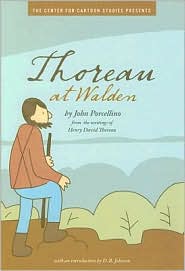
Thoreau at Walden [The graphic novel]
Thoreau, H. D. (Author), & Porecellino, J. (Adapter) (2008). Thoreau at Walden. New York, NY: Hyperion. ISBN: 978-1-4231-0038-6
Author: Henry David Thoreau
Website (Wikipedia): http://en.wikipedia.org/wiki/Henry_David_Thoreau
Adapted & Illustrated By: John Porcellino
Website: http://www.king-cat.net/index.html
Media Used: Pen on a white and light brown background.
Summary: Using Thoreau's own words, from Walden, Civil Disobedience, Walking, and his journals, this graphic novel tells the story of Thoreau's two years living in the woods and the night he spent in jail.
Personal Thoughts: This book flowed really well. Since the words were all taken directly from Thoreau, the book read like a journal. Short sentences introduced Thoreau's ideas and thoughts in a way that worked well in the graphic novel format. The illustrations were done with a light hand. Clear solid pen lines on a white background were paired with splashes of brown to add contrast. The drawing style reminded me of Kinney's Diary of a Wimpy Kid - simple and too the point, which makes for easy reading. While I found this book in the Young Adult graphic novel section of my library, the format makes this material more accessible to a younger audience (5th grade or up) then the original writings by Thoreau would be (high school level). Created in part by the Center for Cartoon Studies, like the Satchel Paige: Striking Out Jim Crow book, the panel discussion questions provided in the back of the book make this book a great resource for classroom use.
Lesson Plan (under construction): Living life without modern technology. Getting back to nature discussion. Could you survive one day without technology? Journal assignment.
Thursday, July 21, 2011
Robert Louis Stevenson's Treasure Island: The Graphic Novel
Stevenson, R. L. (Author), & Hamilton, T. (Adapter) (2005). Robert Louis Stevenson's treasure island: The graphic novel. New York, NY: Puffin. ISBN: 0-14-240470-5
Author: Robert Louis Stevenson
Website (Wikipedia): http://en.wikipedia.org/wiki/Robert_Louis_Stevenson
Adapted By: Tim Hamilton
Website: http://hamilton-tim.pair.com/CUTBLEED/
Media Used: Pencil, Bristol board, India ink, metal pen nibs, brushes (old & new), grease crayon, carved wooden stick. Pages were then scanned into a computer and gray tone were added to the art using Photoshop.
Summary: Jim Hawkins, son of an innkeeper, finds a map hidden in a deceased guest's belongings and with pirates and danger everywhere is caught up in the search for the treasure it leads to.
Personal Reaction: I have had the pirate's song ("yo ho ho and a bottle of rum") stuck in my head since reading this graphic novel yesterday. Not having read this book as a teen, my brain keeps wanting to override the books view of pirates with Disney's Pirates of the Caribbean. Overall the story adapted well to a graphic novel format and made the novel more accessible to reader. The dark shadowy faces help add to the feeling of suspense and danger. The text was well suited to a younger 5th to 7th grade audience despite the use of some Old English - which could be used as a great vocabulary builder.
Fiction in Graphic Novel Format
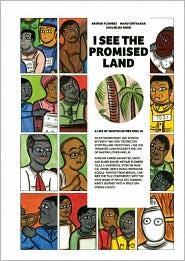
I See the Promised Land: A life of Martin Luther King, Jr.
Flowers, A. R. (2010). I see the promised land: A life of Martin Luther King, Jr.. [Chennai], India: Tara Books. ISBN: 978-93-80340-04-3
Author: Arthur Flowers
Website: http://aalbc.com/authors/arthurflowers.htm
Illustrator: Manu Chitrakar
Website: No illustrator website
Design By: Guglielmo Rossi
Website: http://guglielmorossi.com/
Media Used: Painted using traditional Bengali scroll art
Summary: Oral storytelling meets traditional Bengali scroll art to create this graphic novel which tells about the life of Martin Luther King Jr. - the Baptist preacher, Nobel Peace Prize winner, African American civil rights leader - who was assassinated in 1968.
Personal Reaction: Since the text was created by a blues singer who is also a master oral storyteller, I really shouldn't be surprised that the text in this book was so wonderfully put together. The rhythm of the words draw the reader in with its distinct beat. You can see Flowers perform excerpts of the book here. At first I thought that the different font sizes and scattered text would interrupt the flow of my reading, but it had the opposite effect. The way the text was laid out on the page enhances the rhythm of the story. The 2 page spreads with large white text on a black background make you sit up and take notice of the direct quotes from King. The artwork is wonderfully done, helping to drive the story forward, and depicting scenes the struggles of the time. A wonderfully book that is an easy edition to any classroom or school library.
Use of Rhythm: The entire book is set to a particular rhythm making it a good choice for reading aloud.
Curricular Connection: 7th to 12th grade - Civil Rights History & the life of Martin Luther King Jr.
Lesson Plan (under construction): talk about the civil rights movement.
Wednesday, July 20, 2011
A.D.: New Orleans After the Deluge
Neufeld, J. (2009). A.D.: New Orleans after the deluge. New York, NY: Pantheon Books.
ISBN: 978-0-307--37814-9
Author & Illustrator: Josh Neufeld
Website: http://www.joshcomix.com/
Media Used: Pencil and ink on alternating solid color backgrounds (aqua, yellow, pale green, pale blue, pink,) for the first half of the book. The second half of the book starts layering a background color with a different color to highlight special objects or persons.
Summary: This graphic novel, based on real life stories from Hurricane Katrina survivors, chronicles the days leading up to and following the storm and provides a much needed perspective of what was happening from those who had first hand experience.
Personal Thoughts: The opening pages to this book are a series of landscape drawings depicting how New Orleans looked before (August 22, 2005), during, and after (August 31, 2005) the storm. We then meet our characters in a very opening movie credits sort of way, which I enjoyed. Leo & Michelle are a young couple who decided to wait until the last minute to evacuate due to financial hardship. Abbas & his friend Darnell who decide to stay and protect Abbas' convenience store from possible looters. Kwame is a high school senior who evacuates with his family. Denise and her family ride out the storm in New Orleans, moving from their apartment to the Central City hospital to the Convention Center. Doctor Brobson rides out the storm at home by throwing a hurricane party. This book provides a great viewpoint of the storm from firsthand experiences. The depiction of certain aspects of daily life or basic needs people had really helped me to relate with the characters. Neufeld's website & Randomhouse provides an online teachers guide to accompany the book.
Lesson Plan #3: Hurricane Katrina
Non-Fiction in Graphic Novel Format
Awards:
Best American Comics, 2010
Mother Jones Top Books of 2009
New York Best Comics of 2009, Runner Up
MTV.com Best Nonfiction Comic of 2009
San Francisco Chronicle “Best in Comics”
Tuesday, July 19, 2011
Yummy: The Last Days of a Southside Shorty
Neri, G. (2010). Yummy: The last days of a southside shorty. New York, NY: Lee & Low Books. ISBN: 978-1-58430-267-4
Author: Greg Neri
Website: www.gregneri.com/
Illustrated by: Randy DuBurke
Website: www.randyduburke.com/
Media Used: Black and white illustrations done in pencil and ink.
Summary: This graphic novel is based on the true story of eleven-year old Robert "Yummy" Sandifer who appeared on Time magazine in September 1994 after shooting a 14 year old girl and then being shot by members of his own gang.
Personal Reaction: Wow, this is the kind of sad heart wrenching type of story that could only come from a real life tragedy. Neri writes that after all the facts came out "there are no winners in this story, only losers." The narrator, a fictional character, struggles to make sense of everything that happened - comparing the thug Yummy to the child Robert. Yummy is like many at risk youths who come from a broken home, are in and out of the system, and are looking for a sense of belonging and control. Neri posts a copy of the original Time magazine article on his website. A short read (only took me 20 mins), this book is a great opening book to start a discussion about gangs, neighborhood violence, and what could have been done differently - by the government, by neighbors, by police, and by family - and what type of preventative programs need to be in place.
Non-Fiction in Graphic Novel Format
Twilight: The Graphic Novel, Volume 1
Meyer, S. (Author), & Kim, Y. (Adapter) (2010). Twilight: The graphic novel, volume 1. New York, NY: Yen Press.
ISBN: 978-0-7595-2943-4
Author: Stephenie Meyer
Website: http://www.stepheniemeyer.com/
Adapted & Illustrated By: Young Kim
Website: No illustrator website - Interview: http://www.twilightnews.co.uk/2010/03/24/qa-with-young-kim/
Media Used: Pencils and a sketchbook were used to create the initial thumbnails. Sketches were then digitalized using a computer, tablet and tablet pen. The drawing and coloring were done in Corel Painter, and the toning and final touches were done in Adobe Photoshop. Mostly black, white, gray, and brown illustrations with some scenes in color.
Summary: The mega hit book and movie series is now available in graphic novel format! Follow Bella as she moves into the town of Forks, meets Edward and the rest of the Cullens family, and discovers their dark secret.
Personal Reaction: Okay so I didn't enjoy the movie and also didn't enjoy the book series until the getting to the last book. Bella, as the main character, seems like a whiny and weak person - which is in direct opposite of the type of female characters I enjoy reading about. So why did I read the graphic novel? 1) the series is so popular, I keep trying to see it from a different point of view and 2) a different format can sometimes change the tone of a story. The graphic novel was definitely my favorite version of the story and I think this was because Bella's whininess was cut back. A lot of her inner dialogue was adapted (cut out) to fit the graphic novel format and more of the visual aspects of the story were brought to the forefront. Overall, I'm glad I read this version of the story because I enjoyed it the most. Volume 1 of the graphic novel covers the first half of the first book - from Bella moving into Forks, until Edward takes Bella to the meadow in the woods to show her his secret.
Fiction in Graphic Novel Format
The Lightning Thief: The Graphic Novel
Riordan, R. (Author), & Venditti, R. (Adapter) (2010). The lightning thief: The graphic novel. New York, NY: Disney/Hyperion Books. ISBN: 978-1-4231-1696-7
Author: Rick Riordan
Website: www.rickriordan.com/
Adaptor: Robert Venditti
Website: www.robertvenditti.com/
Illustrated by:
Attila Futaki (art) http://attilafutaki.blogspot.com/
JosƩ Villarrubia (color) http://en.wikipedia.org/wiki/Jos%C3%A9_Villarrubia
Orpheus Collar (layouts) http://www.orpheusartist.com/
Chris Dickey (lettering) No illustrator website
Media Used: Full color illustrations done in a classic comic book format.
Summary: Percy, Poseidon’s half mortal son, Grover the satyr, and Annabeth, Athena’s half mortal daughter, must go on a quest to find Zesus’s stolen lightning bolt, along the way battling the Furies, and Ares, the god of war.
Personal Reaction: I've read the books, I've seen the movie, and now I've read the graphic novel. Out of all of them, I prefer the book version the best, but the graphic novel definitely comes in at second. The illustrations are well done and the story was well adapted. The book has a lot of action going on from chapter to chapter and that action is a good fit in a graphic novel format. There are some details in the graphic novel that were changed or left out such as Percy's fight with Luke at the end (doesn't happen in the GN) and Percy's battle with the Furies on the bus is mentioned but not illustrated.
Monday, July 18, 2011
Excalibur: The Legend of King Arthur, a graphic novel
Lee, T. (2011). Excalibur: The legend of King Arthur, a graphic novel. Somerville, MA: Candlewick Press, 2011. ISBN:978-0-7636-4644-8
Author: Tony Lee
Website: http://www.tonylee.co.uk/
Illustrator: Sam Hart
Website: http://www.samhartgraphics.com/
Media Used: Illustrations were created digitally. The book's text was set in Wild Words and Archetype.
Summary: In this graphic novel, we learn about the boy, Arthur, who pulls the sword from the stone, travels with the wizard Merlin, and trains in Avalon in order to become king, build Camelot, and fight Morgana and Mordred.
Personal Reaction: I liked this version of Arthur's life. It glosses quickly over Uther Pendragon's pack with the Unseelie court (Winter/Night fae) in order to gain Ingraine as a wife. It shows Arthur growing up with Ector and Cei, his pulling the sword out to protect them, then training in the Seelie court (Spring/Day fae). It shows the tragic love stories of Arthur and Vivianne, the lady of the lake, as well as that of Lancelot and Guinevere. It also tells the stories of some of the fae and knights - though not much. The art is well done with different spread being drawing on a background of dominating color such as purple, red, orange, or blue backgrounds.
Pride and Prejudice and Zombies: The graphic novel
Austen, J. (Author), Grahame-Smith, S. (Author), & Lee, T. (Adapter) (2010). Pride and prejudice and zombies: The graphic novel. New York, NY: Del Rey. ISBN: 978-0-345-52068-5
Author: Jane Austen
Website (Wikipedia): http://en.wikipedia.org/wiki/Jane_Austen
Author: Seth Grahame-Smith
Website: http://sethgrahamesmith.com/
Adapter: Tony Lee
Website: http://www.tonylee.co.uk/
Illustrator: Cliff Richards
Website (Interview): http://www.glasshousegraphics.com/creators/pencilers/cliffrichards/
Media Used: Classic comic book style in black and white pencil and ink.
Summary: A strange plague is taking over England turning those infected into "unmentionables" (aka zombies). Those left are devoted to mastering the deadly arts and Elizabeth Bennet is one of the best. Now she must battle wits with the conceited Mr. Darcy.
Personal Reaction: A good book for those who like gruesome zombie slayings and who are familiar with the original Pride and Prejudice by Austen (or maybe the written edition of Pride and Prejudice and Zombies by Grahame-Smith). I think having a background knowledge would help since the graphic novel jumps right in to the storyline and is a bit chaotic with zombie attacks happening every few pages. I also had a hard time figuring out which character was which at the beginning - names weren't used to frequently at first and all the characters looked the same at first to me as well. Near the middle of the book though I was able to sort the characters out and simply enjoy the story. Enjoyable enough that I would consider searching out the written edition by Grahame-Smith to read as well as some of the other zombie-spin off novels that are out there.
Thursday, July 14, 2011
Laika
Abadzis, N. (2007). Laika. New York, NY: First Second.
ISBN: 1-59643-302-7
Author & Illustrator: Nick Abadzis
Website: http://www.nickabadzis.com/
Color By: Hilary Sycamore
Website: No website
Media Used: Lettering done in Vostok using Photoshop. Drawing done in pencils and ink then colored in.
Summary: A blend of fact and fiction, the story of Laika the dog, Earth's first space traveler, is told from three different viewpoints - Korolev, a Soviet engineer; Yelena, the technician responsible for Laika; and Laika herself.
Personal Reaction: Okay before this semester, I couldn't remember if I had ever heard of Laika before. I knew about the monkeys sent into space, but didn't know that they had sent dogs up during the space race. So while I suspected that this book wasn't going to end well, I wasn't aware prior to reading this book that the dog was going to pass away. I'm a dog person, so I totally related to Yelena's distress that her dog was getting shot into space, alone, panicked, and suffering. This book definitely could be used as a supplement for learning about the space race history, or could be used as a writing prompt for students asking "What would you do?" in this scenario.
Anne Frank: The Anne Frank House authorized graphic biography
Jacobson, S., & Colon, E. (2010). Anne Frank: The Anne Frank House authorized graphic biography. New York, NY: Hill and Wang.
ISBN: 978-0-8090-2684-5
Author: Sid Jacobson
Website (Wikipedia): http://en.wikipedia.org/wiki/Sid_Jacobson
Illustrator: Ernie Colón
Website (Wikipedia): http://en.wikipedia.org/wiki/Ernie_Col%C3%B3n
Media Used: Full color illustrations in a comic book format. Panels images were adapted from rare photographs of Anne and her family provided by the Anne Frank House in Amsterdam.
Summary: This graphic novel tells how Anne's parents met, the family's life in Frankfurt, their move to Amsterdam, life in the Annex, the betrayal, life in the concentration camps, Anne's death, her father's survival, and the publication of her diary.
Personal Reaction: This graphic novel goes beyond the diary telling about how Anne's parents met, the family's day to day life in Frankfurt and Amsterdam, life in the Annex, how the family was betrayed and arrested, their lives in the concentration camps, how they were split up, how or when they each died, and Anne's father's life after being freed. I was never really happy with how the diary ended when I read it as a student. I wanted to know more about Anne's life and death. This graphic novel does that by giving you a better overview of the life lived by all the family members. Definitely a must read for students, either on its own or as a supplement to The Diary of Anne Frank. The illustrations are in a comic book style, but a good amount of realism was incorporated into those drawings by using real photographs as models.
Non-Fiction in Graphic Novel Format
Lesson Plan (under construction): Read a Anne Frank graphic novel and compare to the diary. Read Maus and compare and contrast their experiences to those in Anne Frank's graphic novel.
Stephen King's N.
King, S. (Author), & Guggenheim, M. (Adapter). (2010). Stephen King's N. New York, NY: Marvel Worldwide. ISBN: 978-0-7851-3453-4
Author: Stephen King
Website: www.stephenking.com/
Adapted By: Marc Guggenheim
Website (Wikipedia): http://en.wikipedia.org/wiki/Marc_Guggenheim
Illustrated By:
Alex Maleev (art) http://www.maleev.com/
Chris Eliopoulos (lettering) http://www.desperatetimes.com/
Media Used: Full color illustrations done in a classic comic book style. Dark shadows, dusty colors, and backgrounds mimicking the sunset fit this tale of horror.
Summary: In a rural field in Maine where a circle of stone pillars stand, something evil watches and waits for release. N. discovered the stone's secret and died rather then allow its escape. Now others follow the clues left he behind.
Personal Reaction: First I read 30 Days of Night, and now this book by the King of horror. I am starting to appreciate graphic novels as the perfect vehicle for horror stories. I've never been a fan of horror movies - finding them unbelievable, too gruesome/bloody, or victims of bad effects/makeup. Horror novels were a little more suspenseful but can sometimes drag depending on the author's ability to set a proper mood. Graphic novels on the other hand provide direct images which convey the tone, suspense, and setting of the story wonderfully which allows the reader to focus more on the story itself. It is no wonder that King is a master at providing suspense - Rose Red, Carrie, Children of the Corn anyone? King and Guggenheim wrote this tale with the intent of it being made first into a series of twenty-five 1.5 minute webisodes which would then be created into a graphic novel.
Use of Symbol: The circle of stones symbolize a doorway between our reality and another dark reality of gruesome monters. The stone gate also represent a gate in our minds which separates of sanity from insanity. Odd numbers in the story represent the door opening, while even numbers represent the door closing.
Wednesday, July 13, 2011
Troublemaker Book One
Evanovich, J., & Evanovich, A. (2010). Troublemaker book one: A Barnaby and Hooker graphic novel. Milwaukee, OR: Dark Horse Books. ISBN: 978-1-59582-488-2
Author: Janet Evanovich & Alex Evanovich
Website: http://www.evanovich.com/
Illustrated by: Joƫlle Jones
Website: http://www.joellejones.com/
Additional illustrations by:
Ben Dewey (background pencils) http://www.benjamindewey.com/
Andy Owens (inks) No illustrator website
Dan Jackson (colors) No illustrator website
Nate Piekos of Blambot (letters) http://www.blambot.com/
Media Used: Full color illustrations in a classic comic book format with large picture panels that are arranged in an easy to read format.
Summary: Barnaby and Hooker, together again, in their first graphic novel. Called to Miami to find a missing friend, they escape exploding dolls, dodge Hooker's mom, go trash diving, escape a black voodoo cult, and that's just the beginning.
Personal Reaction: I'm a fan of Evanovich's numbers series. Her writing style and humor make for fun and action packed reading. Troublemaker is actually the third book in her Alex and Barnaby series [the first two titles of the series were released in novel format]. Mom (Janet) & daughter (Alex) teamed up to create the rest of this series in a purely graphic novel format. It's an interesting concept, to move an existing novel series into a purely comic format, but I think it works. Adult fans may now be tempted to pickup a graphic novel while the new format is definitely appealing to teens who will want to search out the novels.
The Alchemist: A Graphic Novel
Author: Paulo Coelho
Website: http://www.paulocoelho.com/
Adapted By: Derek Ruiz
Website: http://twitter.com/#!/DerekRuiz
Illustrated By: Daniel Sampere
Website: http://danielsampereart.blogspot.com/
Media Used: Full color illustrations done in a classic comic book style.
Summary: Coelho's story, The Alchemist, has been adapted into a graphic novel format. Follow the shepard boy, Santiago, as he travels from Spain into the Egyptian desert in search of the pyramids and treasure while discovering his own Personal Legend.
Personal Reaction: I never had the chance to read Coelho's The Alchemist. I had only heard of the title after I started library school and started skimming school reading list on a regular basis. Reading this graphic novel has me wanting to go out and read the original book. The graphic novel was so well crafted, understandable, and well drawn that I was left wanting more - but in a good way. I would suggest this book to a relucant reader or for it to be used as a supplement to the original material - though the graphic novel is certainly able to stand alone. The illustrations were colorful and full of detail. They definitely helped to expand my knowledge of what was happening in the story and in Santiago's travels.
Fiction in Graphic Novel Format
Sunday, July 10, 2011
The Metamorphosis (Comic Version)
Kafka, F. (Author), Kuper, P. (Adapter). (2003). The metamorphosis [Comic Version]. New York, NY: Three River Press. ISBN: 978-1-40000-4795-6
Author: Franz Kafka
Website (unofficial): http://www.kafka.org/
Adapted and Illustrated By: Peter Kuper.
Website: http://www.peterkuper.com/
Media Used: pen and ink.
Summary: Gregor Samsa awakes one morning to find that he has transformed, this time in graphic format. Gregor and his family must come to terms with his ghastly change, and learn how to move on.
Personal thoughts (provided by S.Butts): I always found this book very upsetting. The clinical way that Kafka tells the story, and even how the characters react to the bizarre situation in the book with such cold practicality, always made me feel a little ill. No doubt that was part of the effect Kafka was aiming for. This graphic novel version I think is able to convey that same absurdity, making the reader's experience all the more upsetting because they can actually see the state Gregor is living in, and the expressions of disgust and horror he sees on the faces of those around him. Each page is packed with hectic, frightening images, heavily shadowed and bleak-looking, helping to express Kafka's disturbing text. Kuper also adds some cartoonish humor to the images (the three roomers spitting on the floor simultaneously with a "Pppptttooo") which might also help to express Kafka's sly jokes. In all, I think this graphic novel is true to Kafka's story in that the overall feel and message is retained. It does overplay much of the subtlety of the original.
"The Classics Revisited" Group Project - Check out our group's presentation of this and other literary classic graphic novel adaptations that we have suggested for high school students.
Curricular Connections: High School Literature
This graphic novel could be used as part of a high school summer reading list, in lieu of the original title, or as a supplement to a lesson on Kafka in a literature class. I found a wiki for just such a class assignment - I thought the students' insights were impressive: https://ibenglish11whs.wikispaces.com/message/view/Assignments/30927919?o=20
The Odyssey (All Action Classics No. 3)
Homer (Author), & Mucci, T. (Adapter). (2009). The odyssey [All action classics no. 3]. New York, NY: Sterling. ISBN: 978-1-4027-3155-6
Author: Homer
Website (Wikipedia): http://en.wikipedia.org/wiki/Homer
Adapted By: Tim Mucci
Website: http://www.blogger.com/profile/15302772860271992330
Illustrated By:
Ben Caldwell - http://www.actioncartooning.com/
Rick Lacy - http://ricklacy.blogspot.com/
Emanuel Tenderini - no illustrator website
Media Used: pencil and digital colors
Summary: Homer’s mythic tale of heroism, vengeance, and homecoming is re-written in graphic novel format. All of the pivotal characters and plot points are portrayed.
Personal Thoughts (Provided by S.Butts): I always loved mythology, going out of my way to read every story I could, memorizing all of the characters and their significance. The tales of Greek heroes still play a part in our modern conversation, and as evidenced by such titles as Percy Jackson, we as a culture still find importance in these literary icons. However, if a student is not gripped by the same love of these tales as many of us have, slogging through the Iliad and the Odyssey might be daunting. This All-Action Classics interpretation (#3 in a great series) makes the story accessible to a more general audience, while staying true to the original. The colorful artwork shows the beasts such as the Cyclops and Charybdis in all of their legendary horror, the goddesses’ unearthly beauty, and the underworld’s stark loneliness. Even better, the personalities of the characters are conveyed, from Odysseus’ cleverness to the petty rages and indifference of the gods. The illustrations all have a great sense of movement, conveying the stormy environment Odyssues was travelling through on his journey home.
"The Classics Revisited" Group Project - Check out our group's presentation of this and other literary classic graphic novel adaptations that we have suggested for high school students.
Curricular Connection: High School Literature
Appropriate for use for classic literature studies, sections on mythology, and even world history. Best used in conjunction with the original text, and not stand-alone, as it assumes a familiarity with the characters.
Subscribe to:
Posts (Atom)