WELCOME

Hi Everyone and welcome to my blog. This site is being constructed as a project requirement for my Master's Program in Library Science from SJSU.

By the end of this Fall10 Semester I should have everything ready to go!


Showing posts with label 2009 students' list. Show all posts

Thursday, July 28, 2011

The 9/11 Report: A Graphic Adaptation

Jacobson, S.(Editor) (2006). The 9/11 report: A graphic adaptation. New York, NY: Hill and Wang. ISBN: 0-8090-5738-7

Editor: Sid Jacobsen
Website: No author website
Illustrator: Ernie Colón
Website: No illustrator website

Media Used: Mixture of pen, pencil, ink and color illustrations.

Summary: Based on the final reports of the National Commission on Terrorist Attacks Upon the United States, this graphic adaptation attempts to make the findings contained within the report more accessible to all.

Personal Thoughts: Couldn't read this book without remembering where I was that day, what I was doing, and how I was feeling.  It was such a tragic moment in history.  This graphic adaptation does a wonderful job presenting information.  I learned a lot of back history that I was previously unaware of - too young and carefree to be paying much attention to politics at the time.  My favorite section of the book was the four parallel time lines showing the sequence of events for the four airplanes.  My next favorite section was Chapter 9: Heroism and Horror which talks about some of the ground response events.  Probably my least favorite section was the "National Crisis Management" which describes how unprepared agencies were to handle this kind of emergency, especially in terms of communication.  A great book - A Must Read - and a wonderful way to introduce the 9/11 report and events to a wider audience.

Wednesday, July 27, 2011

Brothers in Hope: The Story of the Lost Boys of Sudan

Williams, M. (2005). Brothers in hope: The story of the lost boys of Sudan. New York, NY: Lee & Low Books. ISBN: 1-58430-232-1

Author: Mary Williams
Website: No author website
Illustrator: R. Gregory Christie
Website: http://www.gas-art.com/

Media Used: Illustrations were rendered in acrylic and the text set in Gill Sans.

Summary: Based on true events, this book tells the story of 8 year old Garang who, out tending the cattle, survives his village's destruction and joins a thousand other orphaned boys walking, from Sudan to Ethiopia to Kenya, seeking safety.

Personal Thoughts: I think this is a truly inspirational story about the human will to survive.  The boys in this story band together to help, feed, and protect one another.  They divide up responsibilities and make the decision to travel to Ethiopia as a group by pulling their information.  When I looked at the map at the end of the book, all I could think of was how very far those young boys had to travel - some as young as 5!  In a society that rarely walks more then a block when we can drive, it is hard to fathom.  I really appreciated the Afterward which spoke a little about how the boys were adjusting or struggling in the United States.  I couldn't help but ask myself about all the things I take for granted everyday - like having shoes - and how capable I would be if our roles were reversed.  Great book.

The Enemy: A Book About Peace

Cali, D. (2009). The enemy: A book about peace. New York, NY: Schwartz & Wade Books. ISBN: 978-0-375-84500-0

Author: Davide Cali
Website: http://www.davidecali.com/
Illustrator: Serge Bloch
Website: http://www.sergebloch.net/

Media Used: Illustrations were rendered in China ink on paper and photography

Summary: Two soldiers wait for each other in separate holes on a battlefield.  The soldiers have been told that they are enemies and that the other will kill them.  If only they could end the war...

Personal Thoughts: This is a very thought provoking type of book.  The drawings are very simple - a mixture of doodle like drawings (reminiscent of Shel Silverstein) and photos with splashes of army green and red. As a result, I thought that the story and text was going to be something simple or that there would be a funny twist in the end.   But this book really tried to explain the pointlessness in war.  While there was some humor to be found - the soldier dressed as a bush hiding from the "lion" - it didn't belittle war.  Instead the actions of the soldier being mimicked by the other soldier showed how alike two parties at war can be - in their actions and in their thinking.  The soldier thoughts about hoping the war will end, protecting his family, and what he would do if the enemy surrendered are insightful.  The final scene, is so hopeful, yet fragile - will the enemy get the message? A great opening introduction into a discussion about war.

Age of Bronze: Volume 1. A Thousand Ships

Shanower, E. (2001). Age of bronze: Volume 1. A thousand ships. Orange, CA: Image. ISBN: 1-58240-200-0

Author & Illustrator: Eric Shanower
Website: http://ericshanower.com/

Media Used: Black pencil on a white background

Summary: Following the events leading up to the Trojan War, this graphic novel introduces those involved such as Paris, the lost prince raised as a cowherd; Helen, a beauty that none can resist; and other kings and heroes.

Personal Thoughts: I remember reading the Odyssey and Iliad at a very young age because of an interest in the Greek gods.  I was kind of disappointed that Shanower decided to not include the gods in this graphic novel.  The closest to a god that is represented in the book is the nymph Oenone who is actually portrayed more as a human priestess.  But at the same time, Shanower portrayed those involved in a more human and realistic way which I also appreciated.  The characters had a personality and dept to them that may have made you like or hate them - but regardless made you form some sort of opinion of them.  Very three dimensional versus the flat fairytale like figure that sometimes is represented.  Some of the scenes are definitely not appropriate for younger readers (more sex then violence).  I would suggest for an 18 & over reader or possibly some mature 16 year old.

Sunday, July 24, 2011

The Boy Who Drew Birds: A Story of John James Audubon

Davies, J. (2004). The boy who drew birds: A story of John James Audubon. Boston, MA: Houghton Mifflin Co. ISBN: 0-618-24343-7

Author: Jacqueline Davies
Website: http://www.jacquelinedavies.net/

Illustrated by: Melissa Sweet
Website: http://melissasweet.net/
Media Used: Illustrations are made from mixed media using Twinrocker handmade papers, collage, and found objects.  The story text is set in Regula and the display type is Escrita.

Summary:  Sent to America by his father, John James befriends a pair of nesting birds and devises a way to answer whether those same exact birds will return to the same spot after leaving for the winter.

Personal Thoughts: A great biography book about John James Audubon.  This book captures a child's wonder and interest in the workings of nature.  Certain daily or reoccurring events that are often taken for granted (the birds returning in the spring - the sun rising from the east) are what intrigued some of our greatest scientist into beginning their investigations.  I would include this book in a Science or History lesson as an introduction to Audubon and bird watching and migration.  Davies website includes a helpful teacher's guide with lots of classroom suggestions.

Lesson Plan #2: Nature Journal

Curricular Connection:
  • National Language Arts Standards, Grades 5 to 12
    • Standard 6 -Students apply knowledge of language structure, language conventions, and genre to create, critique, and discuss print and non-print texts.
    • Standard 7 - Students gather, evaluate, and synthesize data from a variety of sources.
    • Standard 8 -Students use a variety of technological and information resources to create and communicate knowledge.
  • National Science Education Standards, Grades 5 to 12
    • Content Standard A - As a result of activities, students develop an understanding of scientific inquiry and abilities necessary for scientific inquiry.
    • Content Standard C - As a result of activities, students develop an understanding of life science.
  • California Education Standards, Grade 7
    • Structure and Function in Living Systems #5 - The anatomy and physiology of plants and animals illustrate the complementary nature of structure and function.

The Composer is Dead

Snicket, L. (2009). The composer is dead. New York, NY: HarperCollins. ISBN: 978-0-06-123628-0

Author: Lemony Snicket
Website: www.lemonysnicket.com/

Illustrated by: Carson Ellis
Website: www.carsonellis.com/
Media Used: Ink and Watercolor

Summary: The composer is now decomposing and it is up to the Inspector to found out who killed him.  Was it the strings, brass, woodwinds, percussion section, or the conductor?

Personal Reaction: A little bit of humor helps to introduce the different instruments that make up an orchestra.  The Inspector reminds me a little of the inspector in the pink panther - just a little slow behind the rest but determined to solve the case.  This would be a great book to read in a music class.  In an advanced class, you could have the appropriate instrument play when they are being discussed.  My version of the book also came with a CD.  On the musical CD, you had the option of listening to the story being narrated with music or just the instrumental background.  I particularly liked the shadow images that depicted the different instruments as well as the orchestra's reply that all musicians "butcher" a composer now and then, but that they also keep them alive.

Friday, July 22, 2011

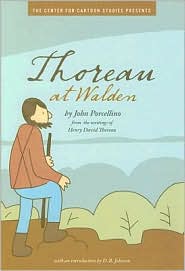
Thoreau at Walden [The graphic novel]

Thoreau, H. D. (Author), & Porecellino, J. (Adapter) (2008).  Thoreau at Walden. New York, NY: Hyperion. ISBN: 978-1-4231-0038-6
Author: Henry David Thoreau
Website (Wikipedia): http://en.wikipedia.org/wiki/Henry_David_Thoreau

Adapted & Illustrated By: John Porcellino
Website: http://www.king-cat.net/index.html

Media Used: Pen on a white and light brown background.

Summary: Using Thoreau's own words, from Walden, Civil Disobedience, Walking, and his journals, this graphic novel tells the story of Thoreau's two years living in the woods and the night he spent in jail.

Personal Thoughts: This book flowed really well.  Since the words were all taken directly from Thoreau, the book read like a journal.  Short sentences introduced Thoreau's ideas and thoughts in a way that worked well in the graphic novel format.  The illustrations were done with a light hand.  Clear solid pen lines on a white background were paired with splashes of brown to add contrast.  The drawing style reminded me of Kinney's Diary of a Wimpy Kid - simple and too the point, which makes for easy reading.  While I found this book in the Young Adult graphic novel section of my library, the format makes this material more accessible to a younger audience (5th grade or up) then the original writings by Thoreau would be (high school level).  Created in part by the Center for Cartoon Studies, like the Satchel Paige: Striking Out Jim Crow book, the panel discussion questions provided in the back of the book make this book a great resource for classroom use. 

Lesson Plan (under construction): Living life without modern technology.  Getting back to nature discussion.  Could you survive one day without technology? Journal assignment.

Thursday, July 14, 2011

Laika

Abadzis, N. (2007).  Laika. New York, NY: First Second.
ISBN: 1-59643-302-7

Author & Illustrator: Nick Abadzis
Website: http://www.nickabadzis.com/

Color By: Hilary Sycamore
Website: No website
Media Used: Lettering done in Vostok using Photoshop.  Drawing done in pencils and ink then colored in.

Summary: A blend of fact and fiction, the story of Laika the dog, Earth's first space traveler, is told from three different viewpoints - Korolev, a Soviet engineer; Yelena, the technician responsible for Laika; and Laika herself.

Personal Reaction: Okay before this semester, I couldn't remember if I had ever heard of Laika before.  I knew about the monkeys sent into space, but didn't know that they had sent dogs up during the space race.  So while I suspected that this book wasn't going to end well, I wasn't aware prior to reading this book that the dog was going to pass away.  I'm a dog person, so I totally related to Yelena's distress that her dog was getting shot into space, alone, panicked, and suffering.  This book definitely could be used as a supplement for learning about the space race history, or could be used as a writing prompt for students asking "What would you do?" in this scenario.

Sunday, July 10, 2011

The Metamorphosis (Comic Version)

Kafka, F. (Author), Kuper, P. (Adapter). (2003). The metamorphosis [Comic Version]. New York, NY: Three River Press. ISBN: 978-1-40000-4795-6

Author: Franz Kafka
Website (unofficial): http://www.kafka.org/

Adapted and Illustrated By: Peter Kuper.
Website: http://www.peterkuper.com/
Media Used: pen and ink.

Summary: Gregor Samsa awakes one morning to find that he has transformed, this time in graphic format. Gregor and his family must come to terms with his ghastly change, and learn how to move on.

Personal thoughts (provided by S.Butts): I always found this book very upsetting. The clinical way that Kafka tells the story, and even how the characters react to the bizarre situation in the book with such cold practicality, always made me feel a little ill. No doubt that was part of the effect Kafka was aiming for. This graphic novel version I think is able to convey that same absurdity, making the reader's experience all the more upsetting because they can actually see the state Gregor is living in, and the expressions of disgust and horror he sees on the faces of those around him. Each page is packed with hectic, frightening images, heavily shadowed and bleak-looking, helping to express Kafka's disturbing text. Kuper also adds some cartoonish humor to the images (the three roomers spitting on the floor simultaneously with a "Pppptttooo") which might also help to express Kafka's sly jokes. In all, I think this graphic novel is true to Kafka's story in that the overall feel and message is retained. It does overplay much of the subtlety of the original.

"The Classics Revisited" Group Project - Check out our group's presentation of this and other literary classic graphic novel adaptations that we have suggested for high school students.

Curricular Connections: High School Literature
This graphic novel could be used as part of a high school summer reading list, in lieu of the original title, or as a supplement to a lesson on Kafka in a literature class. I found a wiki for just such a class assignment - I thought the students' insights were impressive: https://ibenglish11whs.wikispaces.com/message/view/Assignments/30927919?o=20

Wednesday, July 6, 2011

Every Human Has Rights

National Geographic. (2009). Every human has rights: A photographic declaration for kids. Foreword by Mary Robinson. Washington, D.C.: Author.
ISBN: 978-1-4263-0510-8

Author: National Geographic
Website: http://www.nationalgeographic.com/

Contribution By: ePals Global Learning Community
Website: http://www.epals.com/

Forward By: Mary Robinson
Website: http://www.theelders.org/elders/mary-robinson

Media Used: full color photographs with computer generated text.

Summary: The United Nations Universal Declaration of Human Rights, rewritten for accessibility to students, was the inspiration for a student writing contest.  The individual declarations, winning student entries, and photographs from National Geographic were then used to create this insiprational book.

Personal Reaction: This book was very well thought out.  The rewording of the Human Rights Declaration to increase its accessibilty to students was a great step in and of itself.  Students often learn about the U.N. and human rights as part of the standard curriculum.  ePals' development of a writing contest based on the newly worded declaration and the use of those writings in the book help to furthur connect this book with a student audience.  The photographs choosen from the National Geographic database were of the high quality expected from the company.  These photographs help to illustrate the people and ideas that the declarations support.  

Curricular Connection: World Language & History-Social Science Grade 10 & 11
California Standard: World Language: Cultures Stage I, II, & III - Recognize, state, and describe the similarities and differences in the target cultures and between the students’ own cultures.
History-Social Science 10.10.1 - Discuss the important trends in the regions today and whether they appear to serve the cause of individual freedom and democracy. 11.9 1 - Discuss the establishment of the United Nations and International Declaration of Human Rights and their importance in shaping modern Europe and maintaining peace and international order.

Gone Wild: An Endangered Animal Alphabet

McLimans, D. (2006). Gone wild: An endangered animal alphabet. New York, NY: Walker.
ISBN: 0-8027-9563-3

Author & Illustrator: David McLimans
Website: http://www.davidmclimans.com/

Media Used: The illustrations were created using a mixture of pencil, pen, brush, India ink, bristol board and computer.

Summary: Each letter of this alphabet has been transformed to represent a different endangered animal with the addition of certain animal characteristics, such as scales, wings, beaks, and horns. Extra information on their habitats, ranges, threats, and status is included.

Personal Reaction: A classmate had mentioned this Caldecott Honor book in a previous class.  At the time I was unable to obtain a copy of the book to look at.  I am glad to have been able to get a copy this time around.  It is definitely worth a look whether your a small child, a teen, or an adult - there's something for everyone inside.  Each letter of the alphabet is beautifully transformed to represent a certain endangered animal.  A little red box in the corner list some of the animal's basic information such as class, habitat, range, threats, and status.  In the top corner of the page, the letter of the alphabet and the animal's common name is listed alongside its scientific name.  The back of the book contains extra information on the animals, organizations, and books for further reading. 

Curricular Connection: 7th Grade Earth Science & 9th - 12th Grade Ecology
California Science Standard: Earth and Life History 7.4.g - Students know how to explain significant developments and extinctions of plant and animal life on the geologic time scale [compare to current animals in danger of extinction]. Ecology 6.b - Students know how to analyze changes in an ecosystem resulting from changes in climate, human activity, introduction of nonnative species, or changes in population size [the information at the back of the book relates how certain animals are being endangered due to such changes].

Thursday, June 30, 2011

Fallout: J. Robert Oppenheimer, Leo Szilard, and the politcal science of the atomic bomb

Ottaviani, J. (2001). Fallout: J. Robert Oppenheimer, Leo Szilard, and the political science of the atomic bomb. Ann Arbor, MI: G.T. Labs.  ISBN: 0-9660106-3-9 

Author: Jim Ottaviani
Website: http://www.gt-labs.com/writers.html

Artists:
Janine Johnston Website (under construction): http://www.janinejohnston.com/
Chris Kemple Website: http://www.redvengeance.com/
Steve Lieber Website: http://www.stevelieber.com/
Vince Locke Website: http://vincelocke.com/
Bernie Mireault Website: http://bem.spiltink.org/
Jeff Parker Website: http://www.parkerspace.com/

Media Used: The cover of the hardback edition is in color, while the rest of the graphic novel is illustrated in shades of black, gray, and white.

Summary:  Ever wonder just how the atomic bomb was created?  Learn about the people and politics behind the creation of the atomic bomb in this graphic novel about the lives of Oppenheimer and Szilard, two of the bomb's creators.

Personal Reaction:  The use of multiple artists, and thus multiple styles of drawing, in creating this book seemed to me to be a good idea.  The multiple styles helped to highlight the different viewpoints, time periods, and events that were taking place. One of my favorite artistic portions of the book included the 'interludes' and 'epilogue' portions which were created by Bernie Mirault because the format (classic comic book style) was easier to follow along with.  The portions by Locke ('school') and Parker ('work') were really hard for me to focus on because of the more messy penciling technique used.  Honestly, I really wanted to just skip over these parts of the book because I was so distracted by the style.  My first impression upon opening the book was "OMG! So much text crammed is crammed onto the page!" This worries me because I don't know many young adults who would be willing to move past that first impression when reading for pleasure.  But, I really enjoyed how the information being discussed was explained either in the dialogue, in small notes. or in the back section.  The book does have a lot of good information crammed into it.  I would recommend for an older (10th grade & up) audience with a strong interest in physics, scientists, or nuclear development.
Non-Fiction in Graphic Novel Format

Use of Onomatopoeia: "Pop" (p.86) is spelled out in the liquid spraying from the champagne bottle to mimic the sound of the cork being released.

Use of Repetition: The word "click" is repeated 61 times on pages 83 to 85 to mimic the constant sound of the control circuit instruments which were vital to determining the scientists safety.

Use of Allusion: The flowers pictured on p. 55 (and in the rest of the book) reference a story told by Frank Oppenheimer in The Day After Trinity which tells how Robert Oppenheimer would go to the woods to pee and return with a flower. [This is explained on p. 215 of Fallout].

Use of Metaphor: "The cloud resembled a giant brain, the convolutions of which were constantly changing." (p. 136)

Use of Simile: "It [the bomb's heat] was like opening a hot oven..." (p. 137).

Curricular Connection: Grades 9 to 12 Chemistry & 11th Grade History
California Standard:  Chemistry: Nuclear Processes - this book can be used to connect historical nuclear development when learning about nuclear processes.   
History: 11.7 Students analyze America’s participation in World War II - 11.7.6. Describe major developments in aviation, weaponry, communication, and medicine and the war’s impact on the location of American industry and use of resources.
11.7.7.
Discuss the decision to drop atomic bombs and the consequences of the decision (Hiroshima and Nagasaki).

Tuesday, June 28, 2011

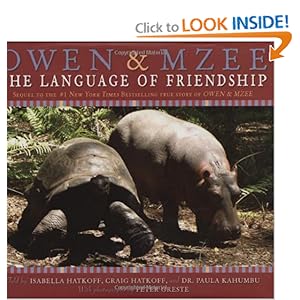
Owen & Mzee: The Language of Friendship

Hatkoff, I., Hatkoff, C., & Kahumbu, P. (2007). Owen & Mzee: The language of friendship. New York, NY: Scholastic Press.
ISBN: 0-439-89959-1

Book & Author's Website: http://www.owenandmzee.com/

Photographs By: Peter Greste
Website (must request access): https://twitter.com/petergreste 

Media Used: Color photographs. 

Summary: The continuing story of the unusual friendship between Owen, a 2 year old orphaned hippo, and Mzee, a 130 year old tortoise.  Discover how they have learned to communicate and how they dealt with being separated for the first time.

Personal Reaction: What can be more lovable then watching a baby hippo and a grumpy old tortoise become friends? This picture book sends multiple messages about friendship (between Owen and Mzee), acceptance (despite being a different species), conservation (importance of saving endangered animals and providing spaces for them to live), and recovery (Owen from being orphaned and Mzee from loneliness).  The story of how far people went, despite the risk of personal injury, to save Owen after the tsunami is inspiring in and of itself.  The color photographs capture Owen and Mzee's friendship wonderfully and help to explain just how they have learned to communicate with one another. 

Curricular Connection: 6th & 7th Grade Earth Science
California Science Standard: Shaping Earth’s Surface 6.2.d - Students know earthquakes, volcanic eruptions, landslides, and floods change human and wildlife habitats [tsunami that affected Owen & the limestone quarry that was reshaped into a wildlife preserve]. Earth and Life History 7.4.g - Students know how to explain significant developments and extinctions of plant and animal life on the geologic time scale [compare to current animals in danger of extinction].

Sunday, June 19, 2011

Satchel Paige: Striking Out Jim Crow

Sturm, J., & Tommaso, R. (2007). Satchel Paige :Striking out Jim Crow. New York, NY: Jump at the Sun/Hyperion Books for Children.
ISBN: 978-0-7868-3900-1
Book Website: http://cartoonstudies.org/books/paige/

My Personal Top Ten

Author: James Sturm
Website: http://www.drawnandquarterly.com/artStudio.php?artist=a3dff7dd55f39b

Illustrator: Rich Tommaso
Website: http://richtommaso.com/home/

Media Used (discussed in detail): James Sturm, who is a cartoonist, provided pencil drawn drafts of the story for Rich Tommaso to use as a guide.  Tommaso used both pen and brush in developing the final illustrations. Photos from the Farm Security Administration-Office of War Information (FSA-OWI) Collection  provided the artists with visual references of how rural life was like during the Jim Crow years.  Tommaso studied the lighting and composition of Thomas Hart Benton which influenced the book's style.  The illustrations in this book definitely set the moods found in the story.  The images of Paige tying his shoes, stretching, and moving the dirt highlight how methodical and unrushed he was regardless of who he was pitching to or who was talking to him.  The fact that each of Paige's motions, from adjusting his belt to raising his hands to lifting his leg,  is illustrated in a separate panel makes you feel the hitter's anxiety and Paige's slowness during his windup while quick transition of the ball then appearing in the catcher's glove illustrates how fast Paige could throw the ball.  My favorite set of panels was when Emmet was fading in and out from the pain of breaking his knee.  Anyone who has been knocked out and has had people standing over them will relate to those panels.  The other panel that really jerked at my emotions was the lynching scene on page 37.  Even though the author had been hinting at it in the text and the illustrator placed the panel last in a 2 page spread, it still seemed to sneak up on me which drove home the reality of the terrible injustices that were happening at that time.

Summary: Baseball hall-of-famer Leroy "Satchel" Paige's story, told from a fictional sharecropper's point of view. During his career he played for dozens of teams, was one of the Negro Leagues’ fastest pitchers, and played as a major league pitcher.
Personal Reaction: I have a soft spot for sports of all kinds in my life, but baseball and softball have always been my favorites.  So you would think that I would enjoy reading sports themed books, but that is usually not the case.  This book's text and illustrations captured the feelings and emotion of the game, as well as that of the time period, extremely well.   I would definitely recommend this book to a baseball or softball fan who is learning about this time in American History.  This is probably best used as a book for older readers (8th grade and up) because of the lynching scene, the scene where Emmet's son gets beaten up, and the one instance of the N-word being used.  A younger audience might not understand the context of these scenes within this time period.     

Use of Repetition: (1) The illustrations of the catcher with the ball in the glove is repeated to stress that Paige pitched so fast the ball just seemed to appear in the catcher's glove. (2) The re-occurring illustrations of Paige's pitching motions which show how he moved at his own pace and no one else's.

Lesson Plan #4: Segregation

Curricular Connection: 8th Grade American History
California Standard 8.11.3: Understand the effects of the Freedmen’s Bureau and the restrictions placed on the rights and opportunities of freedmen, including racial segregation and "Jim Crow" laws.

Friday, June 10, 2011

30 Days of Night

Niles, S. (2004). 30 days of night. San Diego, CA: Idea & Design Works, LLC.
ISBN: 978-0-971977-55-6

2009 Students' Top Ten List Nominee
Author: Steve Niles
Author's Website: http://www.steveniles.com/#tp


Illustrators: Ben Templesmith (art) & Robbie Robbins (letters & design)
Ben Templesmith's Website: http://www.templesmith.com/faze3/
Robbie Robbins Website: No illustrator website
Media Used: Mostly color illustrations against a smoky black and blue grey background with computer graphic letter art.  Comic panels are set against a solid black background.  Use of soft fuzzy lines enables the reader to envision looking out through a snowstorm or a dark foggy night. 

Summary: Barrow, Alaska is a remote town that experiences 30 full days of night once a year.  Vampires have descended on the town, cutting off all communications, in order to enjoy feeding on everyone living there without fear of the sun rising.

Personal Reaction: Just by looking at the cover, you know that this is a horror tale about vampires and not some Twilight love story.  Though to be honest the hero of the book does sacrifice himself selflessly for his wife and the townspeople - so there is a little bit of love.  As with most horror stories, the characters here a fighting a desperate fight simply to survive both the vampires and the extreme Alaskan weather- barely finding enough food or shelter.  The use of soft fuzzy illustrations allows your mind to make its own images of the horror going on.  The limited use of bright splashes of color (particularly the splashes of red blood throughout the scenes) draws the readers eye from scene to scene.  I particularly enjoyed how the first scenes in the book of the sun setting mimics the last scenes when the sun once again rises.      

 Awards: Nominated for Eisner Award (2005)

Thursday, June 9, 2011

Maus: A Survivor's Tale - Part I: My Father Bleeds History

Spiegelman, A. (1986). Maus: A survivor's tale. Part I: My father bleeds history. New York, NY: Pantheon Books.
ISBN: 0-394-74723-2

Author: Art Spiegelman
Author's Website: http://www.barclayagency.com/spiegelman.html

Illustrator: See Author
Media Used: Black ink on a white background.

Summary: Maus tells the story of Art Spiegelman's father, Vladek Spiegelman, a Polish Jew and Holocaust survivor. The story simultaneously tells of Vladek’s life before and during World War II as well as his life later in New York.

Personal Reaction: Once I picked up this book, I was unable to put it down.  It illustrates what daily life was like for Jews before and after the Nazi's came into power.  The hardships and fear they lived with.  Vladek's story of life in Poland is interrupted by his present day life - which improves the telling of the story rather then distracts from it.  The stark black and white illustrations fit the story's material well.  A great recommendation for students learning about the Holocaust.

Metaphor Use: The Jews in the story are represented as skinny mice, the polish as plump pigs, and the Nazis as big buff cats.  Spiegelman used different groups of animals to represent the different nationalities, religions and races involved in the war.  All the animals within a group were identical to one another except for their clothing which helped to highlight how people during that time viewed other's by their race or religion first and foremost.  Characters who were hiding by pretending to be of another race were represented as wearing another animal's face as a mask. 

Non-Fiction in Graphic Novel Format
Curricular Connection: 10th Grade World History
California Standard 10.8: Students analyze the causes and consequences of World War II.

Awards: Pulitzer Prize Special Award Winner (1992)