Jacobson, S.(Editor) (2006). The 9/11 report: A graphic adaptation. New York, NY: Hill and Wang. ISBN: 0-8090-5738-7
Editor: Sid Jacobsen
Website: No author website
Illustrator: Ernie Colón
Website: No illustrator website
Media Used: Mixture of pen, pencil, ink and color illustrations.
Summary: Based on the final reports of the National Commission on Terrorist Attacks Upon the United States, this graphic adaptation attempts to make the findings contained within the report more accessible to all.
Personal Thoughts: Couldn't read this book without remembering where I was that day, what I was doing, and how I was feeling. It was such a tragic moment in history. This graphic adaptation does a wonderful job presenting information. I learned a lot of back history that I was previously unaware of - too young and carefree to be paying much attention to politics at the time. My favorite section of the book was the four parallel time lines showing the sequence of events for the four airplanes. My next favorite section was Chapter 9: Heroism and Horror which talks about some of the ground response events. Probably my least favorite section was the "National Crisis Management" which describes how unprepared agencies were to handle this kind of emergency, especially in terms of communication. A great book - A Must Read - and a wonderful way to introduce the 9/11 report and events to a wider audience.
WELCOME
Hi Everyone and welcome to my blog. This site is being constructed as a project requirement for my Master's Program in Library Science from SJSU.
By the end of this Fall10 Semester I should have everything ready to go!
Labels
2009 students' list
(16)
2010/2011 Copyright
(24)
Alliteration
(3)
Allusion
(3)
Award Winner
(48)
Caldecott
(7)
Curricular Connection
(29)
DVD
(14)
Fiction Graphic Novel
(11)
Graphic Novel
(36)
LIBR 262A
(76)
LIBR 264 BookTalk
(6)
LIBR 264 Log
(52)
LIBR 264 Prof Reading
(16)
LIBR 264 SciFi Project
(5)
LIBR 271A
(65)
LIBR 271A Group Assign2
(12)
LIBR 271A My Top Ten
(10)
LIBR 285 Journal
(16)
Lesson Plans
(16)
Manga/Anime
(7)
Metaphor
(4)
Movie
(16)
Newberry
(3)
Non-fiction Graphic Novel
(7)
Onomatopoeia
(5)
Personification
(4)
Picture Books for Older Readers
(27)
Repetition
(4)
Rhyme
(4)
Rhythm
(3)
Simile
(5)
Songs/Poems
(16)
Sophisticated Language
(3)
Symbol
(3)
Website
(5)
Showing posts with label Non-fiction Graphic Novel. Show all posts
Thursday, July 28, 2011
Wednesday, July 27, 2011
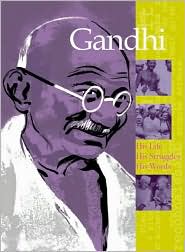
Gandhi: His Life, His Struggles, His Words
Author: Élisabeth de Lambilly
Website: No author website
Illustrator: Severine Cordier
Website: http://zoezoe.ultra-book.com/
Media Used: Mixed media including but not limited to: black & white photographs, pencil, pen, ink and brush, full color comic illustrations, and computer graphics.
Summary: Gandhi, trained as a lawyer, stood up against human suffering, intolerance, and injustice through non-violent methods. He believed every human being had the right to dignity and freedom and lead the people of India in their fight for independence.
Personal Thoughts: This book uses a mixture of photographs, drawings, and comic panels to tell Gandhi's life story. The comic panels, 11 pages long, open the book and describe Gandhi's arrival in South Africa and his being removed from a train because of his race. The comics then briefly show Gandhi's development as he starts to speak out against different injustices; his speaking up at the Indian Congress against British taxes; the British attempt to keep Gandhi from arriving by ship in South Africa after visiting India; an attack on him by protesters; the building of his first ashram; his vow of non-violent methods; and his prison protest fast against the requirement that Indians carry identity cards or face imprisonment. The rest of the book is mostly text that go more in detail about some of the different ways that Gandhi made a difference. Interwoven into the text are illustrations and photographs depicting different events. I found this book in the children's graphic novel section of my local library. The graphic novel portion of this book is smalled compared to the non-fiction information included, but the comic does a wonderful job of encouraging the reader to absorb that non-fiction information. This format works well, since the goal of most of the curricular connected graphic novels that I've read seek to introduce the reader to a topic and hopefully encourage them to read more detail about it in another book.
Non-fiction in Graphic Novel Format
Tuesday, July 19, 2011
Yummy: The Last Days of a Southside Shorty
Neri, G. (2010). Yummy: The last days of a southside shorty. New York, NY: Lee & Low Books. ISBN: 978-1-58430-267-4
Author: Greg Neri
Website: www.gregneri.com/
Illustrated by: Randy DuBurke
Website: www.randyduburke.com/
Media Used: Black and white illustrations done in pencil and ink.
Summary: This graphic novel is based on the true story of eleven-year old Robert "Yummy" Sandifer who appeared on Time magazine in September 1994 after shooting a 14 year old girl and then being shot by members of his own gang.
Personal Reaction: Wow, this is the kind of sad heart wrenching type of story that could only come from a real life tragedy. Neri writes that after all the facts came out "there are no winners in this story, only losers." The narrator, a fictional character, struggles to make sense of everything that happened - comparing the thug Yummy to the child Robert. Yummy is like many at risk youths who come from a broken home, are in and out of the system, and are looking for a sense of belonging and control. Neri posts a copy of the original Time magazine article on his website. A short read (only took me 20 mins), this book is a great opening book to start a discussion about gangs, neighborhood violence, and what could have been done differently - by the government, by neighbors, by police, and by family - and what type of preventative programs need to be in place.
Non-Fiction in Graphic Novel Format
Thursday, June 30, 2011
Fallout: J. Robert Oppenheimer, Leo Szilard, and the politcal science of the atomic bomb
Ottaviani, J. (2001). Fallout: J. Robert Oppenheimer, Leo Szilard, and the political science of the atomic bomb. Ann Arbor, MI: G.T. Labs. ISBN: 0-9660106-3-9
Author: Jim Ottaviani
Website: http://www.gt-labs.com/writers.html
Artists:
Janine Johnston Website (under construction): http://www.janinejohnston.com/
Chris Kemple Website: http://www.redvengeance.com/
Steve Lieber Website: http://www.stevelieber.com/
Vince Locke Website: http://vincelocke.com/
Bernie Mireault Website: http://bem.spiltink.org/
Jeff Parker Website: http://www.parkerspace.com/
Media Used: The cover of the hardback edition is in color, while the rest of the graphic novel is illustrated in shades of black, gray, and white.
Summary: Ever wonder just how the atomic bomb was created? Learn about the people and politics behind the creation of the atomic bomb in this graphic novel about the lives of Oppenheimer and Szilard, two of the bomb's creators.
Personal Reaction: The use of multiple artists, and thus multiple styles of drawing, in creating this book seemed to me to be a good idea. The multiple styles helped to highlight the different viewpoints, time periods, and events that were taking place. One of my favorite artistic portions of the book included the 'interludes' and 'epilogue' portions which were created by Bernie Mirault because the format (classic comic book style) was easier to follow along with. The portions by Locke ('school') and Parker ('work') were really hard for me to focus on because of the more messy penciling technique used. Honestly, I really wanted to just skip over these parts of the book because I was so distracted by the style. My first impression upon opening the book was "OMG! So much text crammed is crammed onto the page!" This worries me because I don't know many young adults who would be willing to move past that first impression when reading for pleasure. But, I really enjoyed how the information being discussed was explained either in the dialogue, in small notes. or in the back section. The book does have a lot of good information crammed into it. I would recommend for an older (10th grade & up) audience with a strong interest in physics, scientists, or nuclear development.
Non-Fiction in Graphic Novel Format
Use of Onomatopoeia: "Pop" (p.86) is spelled out in the liquid spraying from the champagne bottle to mimic the sound of the cork being released.
Use of Repetition: The word "click" is repeated 61 times on pages 83 to 85 to mimic the constant sound of the control circuit instruments which were vital to determining the scientists safety.
Use of Allusion: The flowers pictured on p. 55 (and in the rest of the book) reference a story told by Frank Oppenheimer in The Day After Trinity which tells how Robert Oppenheimer would go to the woods to pee and return with a flower. [This is explained on p. 215 of Fallout].
Use of Metaphor: "The cloud resembled a giant brain, the convolutions of which were constantly changing." (p. 136)
Use of Simile: "It [the bomb's heat] was like opening a hot oven..." (p. 137).
Curricular Connection: Grades 9 to 12 Chemistry & 11th Grade History
California Standard: Chemistry: Nuclear Processes - this book can be used to connect historical nuclear development when learning about nuclear processes.
History: 11.7 Students analyze America’s participation in World War II - 11.7.6. Describe major developments in aviation, weaponry, communication, and medicine and the war’s impact on the location of American industry and use of resources.
11.7.7. Discuss the decision to drop atomic bombs and the consequences of the decision (Hiroshima and Nagasaki).
Sunday, June 19, 2011
Satchel Paige: Striking Out Jim Crow
Sturm, J., & Tommaso, R. (2007). Satchel Paige :Striking out Jim Crow. New York, NY: Jump at the Sun/Hyperion Books for Children.
ISBN: 978-0-7868-3900-1
Book Website: http://cartoonstudies.org/books/paige/
My Personal Top Ten
Author: James Sturm
Website: http://www.drawnandquarterly.com/artStudio.php?artist=a3dff7dd55f39b
Illustrator: Rich Tommaso
Website: http://richtommaso.com/home/
Media Used (discussed in detail): James Sturm, who is a cartoonist, provided pencil drawn drafts of the story for Rich Tommaso to use as a guide. Tommaso used both pen and brush in developing the final illustrations. Photos from the Farm Security Administration-Office of War Information (FSA-OWI) Collection provided the artists with visual references of how rural life was like during the Jim Crow years. Tommaso studied the lighting and composition of Thomas Hart Benton which influenced the book's style. The illustrations in this book definitely set the moods found in the story. The images of Paige tying his shoes, stretching, and moving the dirt highlight how methodical and unrushed he was regardless of who he was pitching to or who was talking to him. The fact that each of Paige's motions, from adjusting his belt to raising his hands to lifting his leg, is illustrated in a separate panel makes you feel the hitter's anxiety and Paige's slowness during his windup while quick transition of the ball then appearing in the catcher's glove illustrates how fast Paige could throw the ball. My favorite set of panels was when Emmet was fading in and out from the pain of breaking his knee. Anyone who has been knocked out and has had people standing over them will relate to those panels. The other panel that really jerked at my emotions was the lynching scene on page 37. Even though the author had been hinting at it in the text and the illustrator placed the panel last in a 2 page spread, it still seemed to sneak up on me which drove home the reality of the terrible injustices that were happening at that time.
Use of Repetition: (1) The illustrations of the catcher with the ball in the glove is repeated to stress that Paige pitched so fast the ball just seemed to appear in the catcher's glove. (2) The re-occurring illustrations of Paige's pitching motions which show how he moved at his own pace and no one else's.
Lesson Plan #4: Segregation
Curricular Connection: 8th Grade American History
California Standard 8.11.3: Understand the effects of the Freedmen’s Bureau and the restrictions placed on the rights and opportunities of freedmen, including racial segregation and "Jim Crow" laws.
ISBN: 978-0-7868-3900-1
Book Website: http://cartoonstudies.org/books/paige/
My Personal Top Ten
Author: James Sturm
Website: http://www.drawnandquarterly.com/artStudio.php?artist=a3dff7dd55f39b
Illustrator: Rich Tommaso
Website: http://richtommaso.com/home/
Media Used (discussed in detail): James Sturm, who is a cartoonist, provided pencil drawn drafts of the story for Rich Tommaso to use as a guide. Tommaso used both pen and brush in developing the final illustrations. Photos from the Farm Security Administration-Office of War Information (FSA-OWI) Collection provided the artists with visual references of how rural life was like during the Jim Crow years. Tommaso studied the lighting and composition of Thomas Hart Benton which influenced the book's style. The illustrations in this book definitely set the moods found in the story. The images of Paige tying his shoes, stretching, and moving the dirt highlight how methodical and unrushed he was regardless of who he was pitching to or who was talking to him. The fact that each of Paige's motions, from adjusting his belt to raising his hands to lifting his leg, is illustrated in a separate panel makes you feel the hitter's anxiety and Paige's slowness during his windup while quick transition of the ball then appearing in the catcher's glove illustrates how fast Paige could throw the ball. My favorite set of panels was when Emmet was fading in and out from the pain of breaking his knee. Anyone who has been knocked out and has had people standing over them will relate to those panels. The other panel that really jerked at my emotions was the lynching scene on page 37. Even though the author had been hinting at it in the text and the illustrator placed the panel last in a 2 page spread, it still seemed to sneak up on me which drove home the reality of the terrible injustices that were happening at that time.
Summary: Baseball hall-of-famer Leroy "Satchel" Paige's story, told from a fictional sharecropper's point of view. During his career he played for dozens of teams, was one of the Negro Leagues’ fastest pitchers, and played as a major league pitcher.
Personal Reaction: I have a soft spot for sports of all kinds in my life, but baseball and softball have always been my favorites. So you would think that I would enjoy reading sports themed books, but that is usually not the case. This book's text and illustrations captured the feelings and emotion of the game, as well as that of the time period, extremely well. I would definitely recommend this book to a baseball or softball fan who is learning about this time in American History. This is probably best used as a book for older readers (8th grade and up) because of the lynching scene, the scene where Emmet's son gets beaten up, and the one instance of the N-word being used. A younger audience might not understand the context of these scenes within this time period. Use of Repetition: (1) The illustrations of the catcher with the ball in the glove is repeated to stress that Paige pitched so fast the ball just seemed to appear in the catcher's glove. (2) The re-occurring illustrations of Paige's pitching motions which show how he moved at his own pace and no one else's.
Lesson Plan #4: Segregation
Curricular Connection: 8th Grade American History
California Standard 8.11.3: Understand the effects of the Freedmen’s Bureau and the restrictions placed on the rights and opportunities of freedmen, including racial segregation and "Jim Crow" laws.
Tuesday, June 14, 2011
21: The Story of Roberto Clemente
Santiago, W. (2011). "21": The story of Roberto Clemente. Seattle, WA: Fantagraphics Books.
ISBN: 978-1-56097-892-3
Book's Website: http://www.21comix.com/
My Top Ten Selection
Author & Illustrator: Wilfred Santiago
Author's Website: http://www.wilfredsantiago.com/
Media Used: Use of a yellow and dark blue color scheme (when mixed together also created a dark black blue color) inspired by the Pittsburgh Pirates uniform. English speakers were represented by orange colored word bubbles and Spanish speakers represented with white colored word bubbles. Used a cartooning and caricature style of drawing in order to help express the story in fun but realistic way while avoiding a "static" feel ("Creator Q&A | 21 author Wilfred Santiago," Mautner, 4/1/2011).
Summary: Chronicles the life of Roberto Clemente including his growing up in Puerto Rico, his baseball career highlights, and his life on and off the field.
Personal Reaction: Roberto Clemente was the first Latino inducted into the National Baseball Hall of Fame. He grew up in a poor family in rural Puerto Rico. He came to the United States to play baseball during the Civil Rights movement, and he, himself, was subjected to what was the common inequalities of the time. This book shows Clemente's own personal beliefs in kindness and justice. A great book to suggest for young baseball fans learning about inequality and the civil rights' movement (though it is more baseball then civil rights).
Use of Allusion: As a child Roberto is shown reciting in class the phrase "Amarillo is yellow!" which alludes to the color of the Pittsburgh Pirates uniform color that he will wear in the future.
Use of Simile: "It's like he has eyes on his fingertips!" & "Arm's like a bazooka!"
Non-Fiction in Graphic Novel Format
Curricular Connection: 9th to 12th grade Social Science
California Historical Interpretation Standard #3: Students interpret past events and issues within the context in which an event unfolded rather than solely in terms of present-day norms and values.
California Standard 11.10.5: Students analyze the development of federal civil rights and voting rights by discussing the diffusion of the civil rights movement of African Americans from the churches of the rural South and the urban North, including the resistance to racial desegregation in Little Rock and Birmingham, and how the advances influenced the agendas, strategies, and effectiveness of the quests of American Indians, Asian Americans, and Hispanic Americans for civil rights and equal opportunities.
Thursday, June 9, 2011
Maus: A Survivor's Tale - Part I: My Father Bleeds History
Spiegelman, A. (1986). Maus: A survivor's tale. Part I: My father bleeds history. New York, NY: Pantheon Books.
ISBN: 0-394-74723-2
Author: Art Spiegelman
Author's Website: http://www.barclayagency.com/spiegelman.html
Illustrator: See Author
Media Used: Black ink on a white background.
Summary: Maus tells the story of Art Spiegelman's father, Vladek Spiegelman, a Polish Jew and Holocaust survivor. The story simultaneously tells of Vladek’s life before and during World War II as well as his life later in New York.
Personal Reaction: Once I picked up this book, I was unable to put it down. It illustrates what daily life was like for Jews before and after the Nazi's came into power. The hardships and fear they lived with. Vladek's story of life in Poland is interrupted by his present day life - which improves the telling of the story rather then distracts from it. The stark black and white illustrations fit the story's material well. A great recommendation for students learning about the Holocaust.
Metaphor Use: The Jews in the story are represented as skinny mice, the polish as plump pigs, and the Nazis as big buff cats. Spiegelman used different groups of animals to represent the different nationalities, religions and races involved in the war. All the animals within a group were identical to one another except for their clothing which helped to highlight how people during that time viewed other's by their race or religion first and foremost. Characters who were hiding by pretending to be of another race were represented as wearing another animal's face as a mask.
Non-Fiction in Graphic Novel Format
Curricular Connection: 10th Grade World History
California Standard 10.8: Students analyze the causes and consequences of World War II.
Awards: Pulitzer Prize Special Award Winner (1992)
Subscribe to:
Posts (Atom)