WELCOME

Hi Everyone and welcome to my blog. This site is being constructed as a project requirement for my Master's Program in Library Science from SJSU.

By the end of this Fall10 Semester I should have everything ready to go!


Sunday, July 24, 2011

13 Words

Snicket, L. (2010). 13 words. New York, NY: HarperCollins. ISBN: 978-0-06-166466-3

Author: Lemony Snicket
Website: http://www.lemonysnicket.com/

Illustrated By: Maira Kalman
Website: http://www.mairakalman.com/
Media Used: Oil painted illustrations

Summary: 13 words are woven into a tale about a "despondent" bird and the dog who tries to cheer her up.  The story is then followed by a short song that retells the story using the 13 words.

Personal Thoughts:  The words in this story range from simple ( ex: baby, bird, cake) to sophisticated (ex: despondent, haberdashery, panache).  The story's plot is simple enough - the dog wants to cheer up his friend bird who is sad - but the way the language is used makes it appropriate for older readers as well as young.  The way the book is presented reminded me of the story of how/why Seuss created Green Eggs and Ham - because of a wager in which he was challenged to write a book using only 50 words.  While there are far more then just 13 words used in Snicket's book, there is still the sense of challenge in its composition. 

Lesson Plan Idea (under construction): A great writing exercise for older readers would be having them select a certain number of words from a box and then have to write a story using those words.  This book, as well as Seuss's, could be used to introduce the concept.

The Composer is Dead

Snicket, L. (2009). The composer is dead. New York, NY: HarperCollins. ISBN: 978-0-06-123628-0

Author: Lemony Snicket
Website: www.lemonysnicket.com/

Illustrated by: Carson Ellis
Website: www.carsonellis.com/
Media Used: Ink and Watercolor

Summary: The composer is now decomposing and it is up to the Inspector to found out who killed him.  Was it the strings, brass, woodwinds, percussion section, or the conductor?

Personal Reaction: A little bit of humor helps to introduce the different instruments that make up an orchestra.  The Inspector reminds me a little of the inspector in the pink panther - just a little slow behind the rest but determined to solve the case.  This would be a great book to read in a music class.  In an advanced class, you could have the appropriate instrument play when they are being discussed.  My version of the book also came with a CD.  On the musical CD, you had the option of listening to the story being narrated with music or just the instrumental background.  I particularly liked the shadow images that depicted the different instruments as well as the orchestra's reply that all musicians "butcher" a composer now and then, but that they also keep them alive.

It's a Book

Smith, L. (2010). It's a book. New York, NY: Roaring Brook. ISBN: 978-1-59643-606-0
Author & illustrator: Lane Smith
Website: http://www.lanesmithbooks.com/

Media Used: Illustrations were done in brush and ink.  The textures were created using oil paints on a hot press illustration board which were then sprayed with acrylic spray.  Images were scanned into Photoshop for final touches.

Summary: While a monkey is reading a book, a jackass comes along and wonders what it is by comparing the book to modern digital media such as blogging and texting.

Personal Reaction:  "Can it text? No. Tweet? No. Wi-Fi? No."  I love the inqusitive jackass's questions as he trys to figure out what a book is by comparing it to the popular digital media that he is familiar with.  His questions could be those of any small child, trying to relate the unfamilar to the familar.  The big monkey is extremely patient (much like an older family member) with the jackass, saying simply that "It's a book."  I think in order to appreciate the humor of the book you need to be older (5th grade & up).  Though we have 5 copies at my local library, so maybe there are lots of parents out there that enjoy reading it?  Defintely check it out - whether you have a kid to read it too or not.  

Hereville: How Mirka Got Her Sword

Deutsch, B. (2010). Hereville: How Mirka got her sword. New York, NY: Amulet. ISBN: 978-0-8109-8422-6
Book Website: http://www.hereville.com/

Author & Illustrator: Barry Deutsch
Website: http://www.amptoons.com/

Colors By: Jake Richmond
Website: http://jake-richmond.livejournal.com/

Media Used: Images were drawn and colored on a computer using Photoshop and a Cintiq tablet.

Summary: Eleven year old Mirka would rather fight dragons then knit. But before she can get the sword she needs, Mirka will need to first dodge bullies, a talking pig, and a witch.

Personal Thoughts:  This adventure/fantasy book was unique in that it was about a girl's life in an Orthodox Jewish village.  Mirka's relationship with her step-mother is healthy - they argue constantly but in a good natured way.  The way her and her mother debate issues teaches Mirka to think fully about the decisions she makes and to defend her choices.  Mirka also stands up to the bullies that are harassing her little brother in a very real way.  Actually most of the book is a wonderful blend of realism and fantasy.  The village, the knitting, and the bullies act in very normal human ways.  The witch, the talking pig, and the trolls are added in a way that makes you wonder if in was a dream or if it really happened.

Friday, July 22, 2011

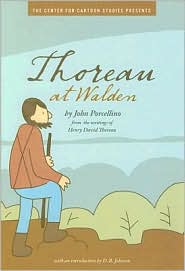
Thoreau at Walden [The graphic novel]

Thoreau, H. D. (Author), & Porecellino, J. (Adapter) (2008).  Thoreau at Walden. New York, NY: Hyperion. ISBN: 978-1-4231-0038-6
Author: Henry David Thoreau
Website (Wikipedia): http://en.wikipedia.org/wiki/Henry_David_Thoreau

Adapted & Illustrated By: John Porcellino
Website: http://www.king-cat.net/index.html

Media Used: Pen on a white and light brown background.

Summary: Using Thoreau's own words, from Walden, Civil Disobedience, Walking, and his journals, this graphic novel tells the story of Thoreau's two years living in the woods and the night he spent in jail.

Personal Thoughts: This book flowed really well.  Since the words were all taken directly from Thoreau, the book read like a journal.  Short sentences introduced Thoreau's ideas and thoughts in a way that worked well in the graphic novel format.  The illustrations were done with a light hand.  Clear solid pen lines on a white background were paired with splashes of brown to add contrast.  The drawing style reminded me of Kinney's Diary of a Wimpy Kid - simple and too the point, which makes for easy reading.  While I found this book in the Young Adult graphic novel section of my library, the format makes this material more accessible to a younger audience (5th grade or up) then the original writings by Thoreau would be (high school level).  Created in part by the Center for Cartoon Studies, like the Satchel Paige: Striking Out Jim Crow book, the panel discussion questions provided in the back of the book make this book a great resource for classroom use. 

Lesson Plan (under construction): Living life without modern technology.  Getting back to nature discussion.  Could you survive one day without technology? Journal assignment.

Thursday, July 21, 2011

Robert Louis Stevenson's Treasure Island: The Graphic Novel

Stevenson, R. L. (Author), & Hamilton, T. (Adapter) (2005). Robert Louis Stevenson's treasure island: The graphic novel. New York, NY: Puffin. ISBN: 0-14-240470-5

Author: Robert Louis Stevenson
Website (Wikipedia): http://en.wikipedia.org/wiki/Robert_Louis_Stevenson

Adapted By: Tim Hamilton
Website: http://hamilton-tim.pair.com/CUTBLEED/

Media Used: Pencil, Bristol board, India ink, metal pen nibs, brushes (old & new), grease crayon, carved wooden stick.  Pages were then scanned into a computer and gray tone were added to the art using Photoshop.

Summary: Jim Hawkins, son of an innkeeper, finds a map hidden in a deceased guest's belongings and with pirates and danger everywhere is caught up in the search for the treasure it leads to.

Personal Reaction: I have had the pirate's song ("yo ho ho and a bottle of rum") stuck in my head since reading this graphic novel yesterday.  Not having read this book as a teen, my brain keeps wanting to override the books view of pirates with Disney's Pirates of the Caribbean.  Overall the story adapted well to a graphic novel format and made the novel more accessible to reader.  The dark shadowy faces help add to the feeling of suspense and danger.  The text was well suited to a younger 5th to 7th grade audience despite the use of some Old English - which could be used as a great vocabulary builder.   

Fiction in Graphic Novel Format

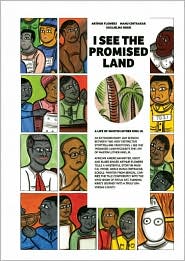
I See the Promised Land: A life of Martin Luther King, Jr.

Flowers, A. R. (2010). I see the promised land: A life of Martin Luther King, Jr.. [Chennai], India: Tara Books. ISBN: 978-93-80340-04-3

Author: Arthur Flowers
Website: http://aalbc.com/authors/arthurflowers.htm

Illustrator: Manu Chitrakar
Website: No illustrator website

Design By: Guglielmo Rossi
Website: http://guglielmorossi.com/

Media Used: Painted using traditional Bengali scroll art

Summary: Oral storytelling meets traditional Bengali scroll art to create this graphic novel which tells about the life of Martin Luther King Jr. - the Baptist preacher, Nobel Peace Prize winner, African American civil rights leader - who was assassinated in 1968.

Personal Reaction: Since the text was created by a blues singer who is also a master oral storyteller, I really shouldn't be surprised that the text in this book was so wonderfully put together.  The rhythm of the words draw the reader in with its distinct beat.  You can see Flowers perform excerpts of the book here.  At first I thought that the different font sizes and scattered text would interrupt the flow of my reading, but it had the opposite effect.  The way the text was laid out on the page enhances the rhythm of the story.  The 2 page spreads with large white text on a black background make you sit up and take notice of the direct quotes from King. The artwork is wonderfully done, helping to drive the story forward, and depicting scenes the struggles of the time.  A wonderfully book that is an easy edition to any classroom or school library. 

Use of Rhythm: The entire book is set to a particular rhythm making it a good choice for reading aloud.

Curricular Connection: 7th to 12th grade - Civil Rights History & the life of Martin Luther King Jr.

Lesson Plan (under construction): talk about the civil rights movement.