WELCOME

Hi Everyone and welcome to my blog. This site is being constructed as a project requirement for my Master's Program in Library Science from SJSU.

By the end of this Fall10 Semester I should have everything ready to go!


Wednesday, July 27, 2011

Age of Bronze: Volume 1. A Thousand Ships

Shanower, E. (2001). Age of bronze: Volume 1. A thousand ships. Orange, CA: Image. ISBN: 1-58240-200-0

Author & Illustrator: Eric Shanower
Website: http://ericshanower.com/

Media Used: Black pencil on a white background

Summary: Following the events leading up to the Trojan War, this graphic novel introduces those involved such as Paris, the lost prince raised as a cowherd; Helen, a beauty that none can resist; and other kings and heroes.

Personal Thoughts: I remember reading the Odyssey and Iliad at a very young age because of an interest in the Greek gods.  I was kind of disappointed that Shanower decided to not include the gods in this graphic novel.  The closest to a god that is represented in the book is the nymph Oenone who is actually portrayed more as a human priestess.  But at the same time, Shanower portrayed those involved in a more human and realistic way which I also appreciated.  The characters had a personality and dept to them that may have made you like or hate them - but regardless made you form some sort of opinion of them.  Very three dimensional versus the flat fairytale like figure that sometimes is represented.  Some of the scenes are definitely not appropriate for younger readers (more sex then violence).  I would suggest for an 18 & over reader or possibly some mature 16 year old.

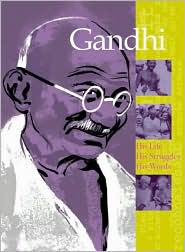
Gandhi: His Life, His Struggles, His Words

Lambilly-Bresson, E. (2010). Gandhi: His life, his struggles, his words. New York, NY: Enchanted Lion Books. ISBN: 1-59270-094-2

Author: Élisabeth de Lambilly
Website: No author website
Illustrator: Severine Cordier
Website: http://zoezoe.ultra-book.com/

Media Used: Mixed media including but not limited to: black & white photographs, pencil, pen, ink and brush, full color comic illustrations, and computer graphics.

Summary: Gandhi, trained as a lawyer, stood up against human suffering, intolerance, and injustice through non-violent methods. He believed every human being had the right to dignity and freedom and lead the people of India in their fight for independence.

Personal Thoughts: This book uses a mixture of photographs, drawings, and comic panels to tell Gandhi's life story.  The comic panels, 11 pages long, open the book and describe Gandhi's arrival in South Africa and his being removed from a train because of his race.  The comics then briefly show Gandhi's development as he starts to speak out against different injustices; his speaking up at the Indian Congress against British taxes; the British attempt to keep Gandhi from arriving by ship in South Africa after visiting India; an attack on him by protesters; the building of his first ashram; his vow of non-violent methods; and his prison protest fast against the requirement that Indians carry identity cards or face imprisonment.  The rest of the book is mostly text that go more in detail about some of the different ways that Gandhi made a difference.  Interwoven into the text are illustrations and photographs depicting different events.  I found this book in the children's graphic novel section of my local library.  The graphic novel portion of this book is smalled compared to the non-fiction information included, but the comic does a wonderful job of encouraging the reader to absorb that non-fiction information.  This format works well, since the goal of most of the curricular connected graphic novels that I've read seek to introduce the reader to a topic and hopefully encourage them to read more detail about it in another book. 

Non-fiction in Graphic Novel Format

Tuesday, July 26, 2011

Lesson Plan #2: Nature Journal

Subject Area: English-Language Arts & Life Science
Grade Level: 7th Grade
Unit Title: Birds
Lesson Title: Nature Journal

Teaching Standards: 
  • National Language Arts Standards, Grades 5 to 12
    • Standard 6 -Students apply knowledge of language structure, language conventions, and genre to create, critique, and discuss print and non-print texts.
    • Standard 7 - Students gather, evaluate, and synthesize data from a variety of sources.
    • Standard 8 -Students use a variety of technological and information resources to create and communicate knowledge.
  • National Science Education Standards, Grades 5 to 12
    • Content Standard A - As a result of activities, students develop an understanding of scientific inquiry and abilities necessary for scientific inquiry.
    • Content Standard C - As a result of activities, students develop an understanding of life science.
  • California Education Standards, Grade 7
    • Structure and Function in Living Systems #5 - The anatomy and physiology of plants and animals illustrate the complementary nature of structure and function.
Performance Objectives: 
Upon completion of this lesson, the student will be able to...
  • Use scientifically descriptive words when observing animals and plants in nature
  • Use a journal format to gather data from real life observation as well as from observation through digital media
  • Identify how the certain structures of a bird’s anatomy are linked to a particular function (i.e.: shape of the beak allows for the consumption of certain foodstuffs).
Materials: 
References: 
This lesson plan is modeled after the “Introduction to the Nature Journal” lesson plan #1 provided by the Smithsonian Institute (Retrieved July 26, 2011):

Preparation
  • Share with students the picture book The boy who drew birds in order to introduce who John James Audubon was.
  • Explain how Audubon wrote in his journal everything he observed about birds and nature, as well as his questions about them.
Presentation
  • Together, on the overhead, read an excerpt of one of Audubon’s journal entries and discuss how Audubon describes his surroundings, his use of wordage, and his use of sketches and samples.
Application:
  • Four different birds will be presented on the overhead projector
    • Students will be given 5 minutes.  They each will choose one bird to describe in two or three sentences using descriptive words.
      • The goal is to provide enough details so that another student will be able to identify which bird was being described.
    • Afterwards the descriptions will be collected and redistributed to another student at random.
      • That student will try to guess which bird is being described and circle those descriptive words that were most helpful.
    • As a class, students will list on the board the descriptive words that were most helpful in describing each bird. 
Evaluation:
  • Evaluate how well each student was able to describe and identify the different birds.
Closure & Assigned Student Work:            
  • Nature Journal
    • Students will keep a nature journal for one week.  Providing at least one entry per day that is one paragraph in length.
    • In their journal, students will provide a description of a nature related subject that they have observed in person during their daily activities.  Some examples can include animals they’ve observed (wild or pets) or plants (such as trees, grass, or flowers) or landscapes (sky, sun, moon)

Trickster: native American Tales: A graphic collection

Dembicki, M. (Editor). (2010). Trickster: Native American tales: A graphic collection. Golden, CO: Fulcrum. ISBN: 978-1-55591-724-1

Editor: Matt Dembicki
Website: http://matt-dembicki.blogspot.com/

Illustrators: There are 45 total illustrators involved in the creation of this collection.  For more information, check out the "contributors" section at the back of the book.

Media Used: Full color illustrations were created using a mixture of styles and techniques, including but not limited too: pen, pencil, ink, brush, watercolor, and computer graphic.

Summary: 21 Native American trickster tales, presented by a variety of artists in this graphic novel collection, tell of the different mischievous activities that different tricksters (coyote, raccoon, raven, rabbit) get in and out of. 

Personal Thoughts: I love trickster tales because they are usually a perfect mixture of humor and teaching.  Sometimes these tales teach about creation (ex: how the stars were put in the sky), about animals (ex: how alligator got his skin), or about morals (ex: why you shouldn't steal from the dead or why you should help a stranger in need).  Some of the tales in this collection I've heard before (Rabbit and the Tug-O-War) and some were new to me (Azban and the Crayfish).  The different styles of illustration work wonderfully to make each story stand out on its own while the trickster theme helps make the stories work together.  I think the use of a graphic novel format really helps the reader visualize what is happening in the stories and helps to move the stories forward.  It's too hard for me to choose my favorite trickster! but its a close race between coyote and rabbit.  A Must read for children, teens, or adults - there's bound to be at least one story in there for a reader to enjoy. 

The Hobbit: An Illustrated edition of the fantasy classic

Dixon, C. (Adapter), & Tolkien, J.R.R. (Author) (1990). The hobbit: An illustrated edition of the fantasy classic. New York, NY: Ballantine Books. ISBN: 0-345-44560-0

Author: J.R.R. Tolkien
Website: http://www.tolkienestate.com/

Adapter: Charles "Chuck" Dixon
Website: http://www.dixonverse.net/
Adapter: Sean Deming
Website: No adapter website

Illustrator: David Wenzel
Website: http://www.davidwenzel.com/
Media Used: Combination of classic pen and watercolor techniques.

Summary: This is a tale of middle earth. A tale of a wizard, 13 dwarves, and one special hobbit, Bilbo Baggins, who go on an adventure to retrieve a horde of treasure that was stolen by the dragon, Smaug.

Personal Thoughts: Tolkien's middle earth is a fully realised world that is one of the fantasy genre's biggest gems.  A few years ago, I read almost all of the books (from The Hobbit to the Lord of the Rings series to the Histories of Middle Earth series) at the insistence of a good friend and was glad I did.  This book tells the tale of Bilbo Baggins (Frodo's uncle) and how he got caught up in an adventure with Gandalf and 13 dwarves who were on an adventure to reclaim the dwarves' mountain from the dragon Smaug.  Along the way Bilbo meets many different characters mentioned or alluded to in the Lord of the Rings series. 

Fiction in Graphic Novel Format

Monday, July 25, 2011

Smile

Telgemeier, R. (2010). Smile. New York, NY: Graphix. ISBN: 978-0-545-24182-3

Author: Raina Telgemeier
Website: http://goraina.com/
Color by: Stephanie Yue
Website: http://jellycity.com/
Media Used: Pencil drawing outlines (done in a cartoon style) with full color illustrations

Summary: Starting in sixth grade when Raina falls and injures her two front teeth and ending in tenth grade when her braces finally come off, this graphic novel tells the very true tale of a normal girl growing up.

Personal Thoguhts: I really like that this book discusses real worries and issues that teens have when growing up.  Based on the author's real like experience, Raina severly damages her two front teeth which then take years of dental work to correct.  No teenager likes being made different.  Raina struggles with physical changes (teeth, acne, puberty) as well as social ones (making and breaking friendships, boyfriends, bullying).  This story brought back my own memories about having braces. A great story to share with any tween, teen or adult.

Sunday, July 24, 2011

The Boy Who Drew Birds: A Story of John James Audubon

Davies, J. (2004). The boy who drew birds: A story of John James Audubon. Boston, MA: Houghton Mifflin Co. ISBN: 0-618-24343-7

Author: Jacqueline Davies
Website: http://www.jacquelinedavies.net/

Illustrated by: Melissa Sweet
Website: http://melissasweet.net/
Media Used: Illustrations are made from mixed media using Twinrocker handmade papers, collage, and found objects.  The story text is set in Regula and the display type is Escrita.

Summary:  Sent to America by his father, John James befriends a pair of nesting birds and devises a way to answer whether those same exact birds will return to the same spot after leaving for the winter.

Personal Thoughts: A great biography book about John James Audubon.  This book captures a child's wonder and interest in the workings of nature.  Certain daily or reoccurring events that are often taken for granted (the birds returning in the spring - the sun rising from the east) are what intrigued some of our greatest scientist into beginning their investigations.  I would include this book in a Science or History lesson as an introduction to Audubon and bird watching and migration.  Davies website includes a helpful teacher's guide with lots of classroom suggestions.

Lesson Plan #2: Nature Journal

Curricular Connection:
  • National Language Arts Standards, Grades 5 to 12
    • Standard 6 -Students apply knowledge of language structure, language conventions, and genre to create, critique, and discuss print and non-print texts.
    • Standard 7 - Students gather, evaluate, and synthesize data from a variety of sources.
    • Standard 8 -Students use a variety of technological and information resources to create and communicate knowledge.
  • National Science Education Standards, Grades 5 to 12
    • Content Standard A - As a result of activities, students develop an understanding of scientific inquiry and abilities necessary for scientific inquiry.
    • Content Standard C - As a result of activities, students develop an understanding of life science.
  • California Education Standards, Grade 7
    • Structure and Function in Living Systems #5 - The anatomy and physiology of plants and animals illustrate the complementary nature of structure and function.