WELCOME

Hi Everyone and welcome to my blog. This site is being constructed as a project requirement for my Master's Program in Library Science from SJSU.

By the end of this Fall10 Semester I should have everything ready to go!


Monday, June 27, 2011

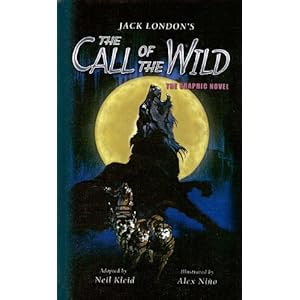
The Call of the Wild

London, J., & Kleid, N. (adapted by). (2006). Jack London's The call of the wild: The graphic novel. New York, NY: Puffin Books.
ISBN: 0-14-240571-X

Original Author: Jack London
Website (not official): http://london.sonoma.edu/

Adapted By: Neil Kleid
Website: http://www.rantcomics.com/

Illustrated By: Alex Niño
Website: No illustrator website

Media Used: Pen and pencil sketches on a white background. 

Summary: Follow Buck, in this graphic novel, as he is taken from his home and into the wild frozen Yukon. Taught the law of club and fang, Buck becomes a superior sled dog until abandoning civilization and joining a wolf pack.

My Personal Reaction: I loved this book as a teenager and it was really refreshing to reread it in a graphic novel format.  The illustrator, Alex Nino, captured the movement and body language of the dogs in the story perfectly.  The body language of the dogs also helps the reader to understand the dogs moods and feelings.  The sketches are mostly outlines and facial expressions, light on details and scenery (which given the frozen white setting is appropriate).  Kleid adapted the story well, managing to keep all of the main storyline (that I could remember) from the original story in the graphic novel.  I can only imagine how much of a challenge it is to take a full length novel and shorten it to a cohesive graphic novel format.  Some movies I know can't even accomplish that, and they have a lot more to work with.  This graphic novel does successfully tell the story on its own alone but could also be used as a supplement to the original novel to further aide the reader's understanding.   

"The Classics Revisited" Group Project - Check out our group's presentation of this and other literary classic graphic novel adaptations that we have suggested for high school students.
 

Fiction in Graphic Novel Format

Use of Sophisticated Language: (1) "Cunning, intelligent; virile and dangerous, he had become a thing of the wild." (2) "Buck watched with apprehension as they haphazardly loaded the sled."

Use of Simile: "And truly Buck was the fiend incarnate, raging at their heels and dragging them down like deer."

Use of Metaphor:  "And truly Buck was the fiend incarnate, raging at their heels and dragging them down like deer."

Curricular Connection: 9th to 12th Grade Classic Literature
California Reading Standards for Literature for grades 6 to 12: Craft and structure - Determine the meaning of words and phrases as they are used in the text, including figurative and connotative meanings; [for example the phrase "the law of club and fang"].

Benno and the Night of Broken Glass

Wiviott, M. (2010). Benno and the Night of Broken Glass. Minneapolis, MN: Kar-Ben.
ISBN: 978-0-8225-9929-6

Author: Meg Wiviott
Website: http://megwiviott.com/
 
Illustrator: Josée Bisaillon
Website: http://joseebisaillon.com/

Media Used (discussed in detail): Bisaillon uses a mixture collage, drawings and digital montage to create the illustrations.  The collage illustrations work well with the material being discussed.  It helps to add a stark or sharp edged look which fits in with the chaos of Kristallnacht (the Night of Broken Glass).  I particularly like the way Bisaillon depicts fire, complete with the flickering shadows a fire casts, within the illustrations.  The images of book burning particularly stuck with me, as did the image of the professor laying on the floor before being dragged away.  The people Benno visits regularly are fully depicted with a range of expressions that reflect the mood of the story.  Bisaillon made an appropriate choice to only show the reader the legs and shadows of the "men in the brown shirts."  It helps the reader to imagine the faceless mobs that gathered as well invoked a feeling of fear and dread.

Summary: Follow Benno the cat as his peaceful neighborhood changes as people's attitudes towards Jews change in 1938 Germany. Learn what happens to the neighborhood when the men in the brown shirts come and destroy Jewish businesses and homes.

Personal Reaction: This book was suggested to me by a friend at work when I mentioned that I was looking for a book that deals with cultural and acceptance.  I thought that in teaching people to accept one another, we must also look at what happens when people do exactly the opposite.  This book shows what happened near the beginning of the Nazi movement against Jews.  It shows the changes in people's attitudes towards one another as a result.  It illustrates how mistrust and violence is the first step towards war. 

Use of Alliteration: "The air filled with screams and shouts, sounds of shattering and splintering glass."

Curricular Connection: 10th grade history
California Standard 10.8: Students analyze the causes and consequences of World War II.

Friday, June 24, 2011

The Dark Hunters Vol. 1

Kenyon, S., & Fialkov, J. H. (adapted by). (2009). The dark-hunters: Volume 1. New York, NY: St. Martin's Griffin. ISBN: 0-312-37687-1

Original Author: Sherrilyn Kenyon
Website: http://www.sherrilynkenyon.com/

Adapted By: Joshua Hale Fialkov
Website: http://www.thefialkov.com/

Art By: Claudia Campos with Glass House Graphics and Groundbreakers Studios
Website: http://www.glasshousegraphics.com/creators/pencilers/ClaudiaMedeiros/index.htm

Art Adapted By: Bill Tortolini
Website: http://www.tortolini.com/

Media Used: Printed in black and white using a traditional manga art style.  The book also reads in the tradtional manga format from right to left (as opposed to the Western style of left to right) and from back to front (when compare to the the Western style of reading). 

Summary: A quiet night alone, far away from men, was all Amanda wanted. Instead, mistaken for her twin sister, she wakes up handcuffed to a gorgeous guy in leather, who claims vampires are after more than blood, they’re after their souls.

Personal Reaction: Ahhh Sherrilyn Kenyon's Dark Hunters series, my guilty pleasure.  I love her books and have read a large portion of the fiction book version of her series just in the last year.  So imagine my joy when I found out she had started a manga version of the series! But would it be good enough? Would the art and the adapted text stand up to the original? YES! Unlike some adaptations that I've read, the adapted text and the illustrations work wonderfully together.  Kenyon's jokes, sarcasm, action and romance translates wonderfully into a manga format.  While the text was paired down, what was left was still the original wording that Kenyon crafted so well. My only complaint? Volume 1 of the manga ends at Chapter 10 of the book! And now I need to go hunt down Volume 2 asap!

Use of Symbol: (1) The bow and arrow mark on the back of Kyrian/Hunter's shoulder represent his status of a Dark-Hunter in service to the Greek Goddess Artemis.  It also represnts his commitment to protecting human kind from the Daimans/vampires/Apollolites. (2) Kyrian/Hunter's eye color changes to represent whether his powers are present (black) or not (hazel-green).

Use of Sophisticated Language: (1) "Valerius was incensed." (2) "There's nothing in Acheron's database about his exact modus operandi and when when I talked to Ash earlier, he said he had no idea where Desiderius came from or who all his targets have been."

Use of Onomatopoeia: Several instances appear in the text.  Some examples from the text include: "Jingle" (keys jingling), "Bark Bark Bark" (dog barking in warning), "Gasp!" (deep breath upon waking up from a blackout), "Click" (door unlocking), "Gah!" (noise made when trying to pull something heavy), "Flush" (sound of a toliet)

Fiction in Graphic Novel/Manga Format

Thursday, June 23, 2011

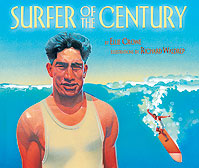
Surfer of the Century: The Life of Duke Kahanamoku

Crowe, E. (2007). Surfer of the century: The life of Duke Kahanamoku. New York, NY: Lee & Low Books.
ISBN: 978-1-58430-276-6
Book Website: At Lee & Low Books

Author: Ellie Crowe
Website: http://www.elliecrowe.com/

Illustrator: Richard Waldrep
Website: No illustrator website

Media Used (discussed in detail): The text is set in 13 point Venis.  The illustrations were rendered in gouache with colored pencil detailing.  The illustrations mimic the art deco paintings that were popular during Duke's time.  The colors and sharp lines used help to capture the moments beautifully.  Looking at the illustration of Duke swimming in the ocean with his arms stretched away from his body, I can almost see him swimming right towards me and off of the page.  The illustrator gives the illusion of a body swimming in motion beautifully.  The iconic picture of Duke surfing with a girl on his shoulders brought back memories of old beach movies I used to watch with my mom - which were more then likely inspired by Duke himself.  I believe the art deco themed illustrations really pair well with the story's time period and mood.      

Summary: The biographical story of five time Olympic swimming medalist, Duke Kahanamoku. Considered to be the ‘father of modern surfing,’ Duke introduced surfing to the world as well as spread his love for the ocean and for Hawaii.

Personal Reaction: Living near Huntington Beach, CA and having seen the statue of Duke Kahanamoku located near the pier, I found it interesting to learn more about his life.  I really only knew that he was a great and iconic surfer, I wasn't aware that he was an Olympic medalist.  While there is some comments on the racism that Duke faced it isn't the main point of the story like some of the other books I've read.  The story also mostly glosses over the financial hardships Duke faced except to point out that he choose to stay as an unpaid amateur in order to continue qualifying for the Olympic games.  The story's text has a very uplifting, almost relaxing, quality to it that reflects the Hawaiian lifestyle wonderfully. 

Use of Onomatopoeia: "BAM! The pistol shot rang out."

Use of Simile: "Wiggling like a little tadpole, Duke made his way back to the canoe."

Curricular Connection: 7th Grade Art
California Standards: (7.2) Creative Expression - Skills, Processes, Materials, and Tools [students could replicate the illustrator's techniques with gouache with colored pencil detailing to create their own drawings]. Connections and Applications (7.5.1) Study the music and art of a selected historical era and create a multimedia presentation that reflects that time and culture [Study of art deco, Hawaiian music, & Duke's time period in America].  (7.5.3) Examine art, photography, and other two and three-dimensional images, comparing how different visual representations of the same object lead to different interpretations of its meaning, and describe or illustrate the results [Students compare photos, and videos of Duke surfing to the illustrations and statues of Duke].

Sunday, June 19, 2011

Satchel Paige: Striking Out Jim Crow

Sturm, J., & Tommaso, R. (2007). Satchel Paige :Striking out Jim Crow. New York, NY: Jump at the Sun/Hyperion Books for Children.
ISBN: 978-0-7868-3900-1
Book Website: http://cartoonstudies.org/books/paige/

My Personal Top Ten

Author: James Sturm
Website: http://www.drawnandquarterly.com/artStudio.php?artist=a3dff7dd55f39b

Illustrator: Rich Tommaso
Website: http://richtommaso.com/home/

Media Used (discussed in detail): James Sturm, who is a cartoonist, provided pencil drawn drafts of the story for Rich Tommaso to use as a guide.  Tommaso used both pen and brush in developing the final illustrations. Photos from the Farm Security Administration-Office of War Information (FSA-OWI) Collection  provided the artists with visual references of how rural life was like during the Jim Crow years.  Tommaso studied the lighting and composition of Thomas Hart Benton which influenced the book's style.  The illustrations in this book definitely set the moods found in the story.  The images of Paige tying his shoes, stretching, and moving the dirt highlight how methodical and unrushed he was regardless of who he was pitching to or who was talking to him.  The fact that each of Paige's motions, from adjusting his belt to raising his hands to lifting his leg,  is illustrated in a separate panel makes you feel the hitter's anxiety and Paige's slowness during his windup while quick transition of the ball then appearing in the catcher's glove illustrates how fast Paige could throw the ball.  My favorite set of panels was when Emmet was fading in and out from the pain of breaking his knee.  Anyone who has been knocked out and has had people standing over them will relate to those panels.  The other panel that really jerked at my emotions was the lynching scene on page 37.  Even though the author had been hinting at it in the text and the illustrator placed the panel last in a 2 page spread, it still seemed to sneak up on me which drove home the reality of the terrible injustices that were happening at that time.

Summary: Baseball hall-of-famer Leroy "Satchel" Paige's story, told from a fictional sharecropper's point of view. During his career he played for dozens of teams, was one of the Negro Leagues’ fastest pitchers, and played as a major league pitcher.
Personal Reaction: I have a soft spot for sports of all kinds in my life, but baseball and softball have always been my favorites.  So you would think that I would enjoy reading sports themed books, but that is usually not the case.  This book's text and illustrations captured the feelings and emotion of the game, as well as that of the time period, extremely well.   I would definitely recommend this book to a baseball or softball fan who is learning about this time in American History.  This is probably best used as a book for older readers (8th grade and up) because of the lynching scene, the scene where Emmet's son gets beaten up, and the one instance of the N-word being used.  A younger audience might not understand the context of these scenes within this time period.     

Use of Repetition: (1) The illustrations of the catcher with the ball in the glove is repeated to stress that Paige pitched so fast the ball just seemed to appear in the catcher's glove. (2) The re-occurring illustrations of Paige's pitching motions which show how he moved at his own pace and no one else's.

Lesson Plan #4: Segregation

Curricular Connection: 8th Grade American History
California Standard 8.11.3: Understand the effects of the Freedmen’s Bureau and the restrictions placed on the rights and opportunities of freedmen, including racial segregation and "Jim Crow" laws.

Friday, June 17, 2011

Brave Margaret

San Souci, R. D. (1999). Brave Margaret: An Irish adventure. New York, NY: Simon & Schuster Books for Young Readers.
ISBN: 0-689-81072-5

Author: Robert D. San Souci
Website: http://www.rsansouci.com/

Illustrator: Sally Wern Comport
Website: http://www.artatlargeinc.com/

Media Used (discussed in detail): The book's text is set in Clearface Roman and the illustrations were originally done in pastels.  Pastels are one of my favorite mediums as they offer a chalky yet vibrant look to the illustrations.  The pastels also allow for a wonderful blending  of colors which helps to give the illustrations a unique textured look.  The book's illustrations are mostly set up in a portrait like fashion - depicting certain action scenes that are described in the text in a way that highlights the emotions and feelings of the story.  My two favorite scenes are the opening picture in which Margaret is leading her cows, due to the bright use of color, and the scene where the the old woman becomes young again using the water of healing because of how life like the glow of the the healing water is.

Summary: Retells the Irish folktale of Brave Margaret, a young woman who falls in love with a ship's captain, battles a sea serpent, and defeats a giant troll.

Personal Reaction: The illustrations of this book really help to highlight the different important events that happen throughout the story.  The story flows well making it a good candidate for reading aloud to a group despite the length.  The depiction of a strong female heroine in a traditional folktale is always a welcomed reading addition.  Margaret's only desire is to travel and be with her love, Simon, in all other things she is brave and selfless.  I also like how the author ended the tale.  Rather then a traditional "happily ever after" or "the end" phrase, I particularly like San Souci's ending sentence: "Their wedding lasted nine nights and nine days, but their happiness lasted a lifetime."

Use of Rhythm: "Fee, fum, fo, fay,  What foolish mortal comes this way? Churl or champion, king's son or knave, One blow of my club puts you in your grave!"

Use of Rhyme: (masculine rhyme - a rhyme in which the stress is on the final syllable of the words)
"Fee, fum, fo, fay, 
What foolish mortal comes this way?

Churl or champion, king's son or knave,

One blow of my club puts you in your grave!"

Use of Personification: "The stones of the black castle danced when the giant slammed the ground with his club."

Use of Alliteration: "But Margaret, spurred on by the sight of Simon's lifeless body, charged forward." 

Use of Onomatopoeia: “The monster hissed but hesitated.”

Thursday, June 16, 2011

The Magic Horse fo Han Gan

Chen, J. H. (2006). The magic horse of Han Gan. (Claudia Zoe Bedrick Trans.). New York, NY: Enchanted Lion Books.
ISBN: 1-59270-063-2

Author & illustrator: Chen Jiang Hong
Website (publisher's): http://www.enchantedlionbooks.com/node/26

Media Used: Chen Jiang Hong painted the illustrations using the same technique that Han Gan used.  The illustrations were painted, using ink and pigment, directly on prepared silk.

Summary: Tells about how the Chinese artist Han Gan became renowned for the horses he drew.  The horses were so realistic looking that a legend was started about how his magical horses could come to life.

Personal Reaction: The book's illustrations are large and would do well when sharing with a group.  The horses are drawn wonderfully - exhibiting strength, power, and movement.  The first part of the book tells the biographical story of Han Gan and the second part of the books transitions into to the legend of the magic horse.  I felt that the story flowed smoothly and was presented much like it would be told during an oral storytelling.  A good legend to me is one that could have happened and a good way to achieve that is to blend fact and fiction.  Unlike most picture books, the pages are numbered which is actually quite helpful if you were presenting this to an older group and wanted them to reference a page during a writing response exercise.

Use of Repetition: Horses, which were Han Gan's favorite thing to draw, are drawn into almost every scene in the book.

Curricular Connection:  5th grade Art
California Standard 5.3: Historical and Cultural Context - Students analyze the role and development of the visual arts in past and present cultures throughout the world, noting human diversity as it relates to the visual arts and artists.